


By the Hughes Media Team
Google quietly turned off one of the most familiar features many business websites have leaned on for years. As of May 2026, the expandable question-and-answer drop-downs that used to appear under search listings are gone.
At Hughes Media, our SEO team has spent more than a decade building search visibility for local service businesses and B2B manufacturers across the United States. Every week, we track the changes happening with Google and search, so our clients do not have to read 40 blog posts and a developer doc to figure out what just happened.
With that being said, here is the plain-English version of what changed, what it actually affects, and what we are strategizing going forward.
SEO Strategies Discussed In This Blog:
- What FAQ rich results were, and why Google pulled the plug
- What this change does and does not affect on your site
- Three other Google updates from spring 2026 that matter
- Whether you should rip FAQ schema out of your pages (spoiler: no)
- The practical next steps Hughes Media is taking for client sites
Quick Summary of Recent Google Changes
| Google Change | When | What It Means for Your Site |
|---|---|---|
| Google drops FAQ rich results | May 7, 2026 | FAQ drop-downs no longer appear in search results. FAQ schema itself is still valid and still useful for AI search. |
| March 2026 Core Update | Mar 27 – Apr 8, 2026 | Broad ranking shift. Sites that show real expertise and clear authorship were rewarded. Thin and AI-spun pages lost visibility. |
| February Discover Core Update | Feb 5, 2026 | Changed how articles surface in Google Discover. Quality and originality matter more than ever there. |
| AI Mode and AI Overviews expansion | May 6, 2026 | New ways for users to explore the web through Google’s AI, with more space for original content and outside sources. |
Who This FAQ Update Affects The Most
This change touches almost every type of website that has been using FAQ schema. That includes:
- Local service businesses with FAQ sections on service pages
- B2B manufacturers using FAQ blocks on product or industry pages
- E-commerce sites with question-and-answer sections on product pages
- Blog posts across any industry that added FAQ schema for extra search real estate
If you have ever asked your developer to add FAQ schema, this applies to you. The good news is the action plan is small, and most of you do not need to change much. It also doesn’t mean that FAQs are now no longer needed. Keep creating them for readers! Google has just decided they will no longer be a factor in search.
If you have any questions about how this affects your site, reach out to the Hughes Media team or call us at 404.848.0487.
What Actually Changed With FAQ Rich Results?
For years, Google let websites mark up their FAQ content with something called FAQPage schema. When Google liked your site, it would show those questions and answers right inside the search results as a drop-down under your listing. That gave you more space on the page, more clicks, and a clear edge over plain blue-link competitors.
Google started cutting back on this feature in 2023 and limited it to government and health sites. On May 7, 2026, Google removed it entirely. According to Google’s own FAQPage developer documentation, here is the full rollback schedule:
- May 7, 2026: FAQ rich results stopped appearing in Google Search
- June 2026: FAQ reporting in Search Console and FAQ support in the Rich Results Test will go away
- August 2026: FAQ support in the Search Console API will be removed
In plain English: Google is no longer giving any extra search visibility to FAQ-marked content, and the tools that used to track FAQ performance are getting shut down, too.
Should You Pull FAQ Schema Off Your Pages?
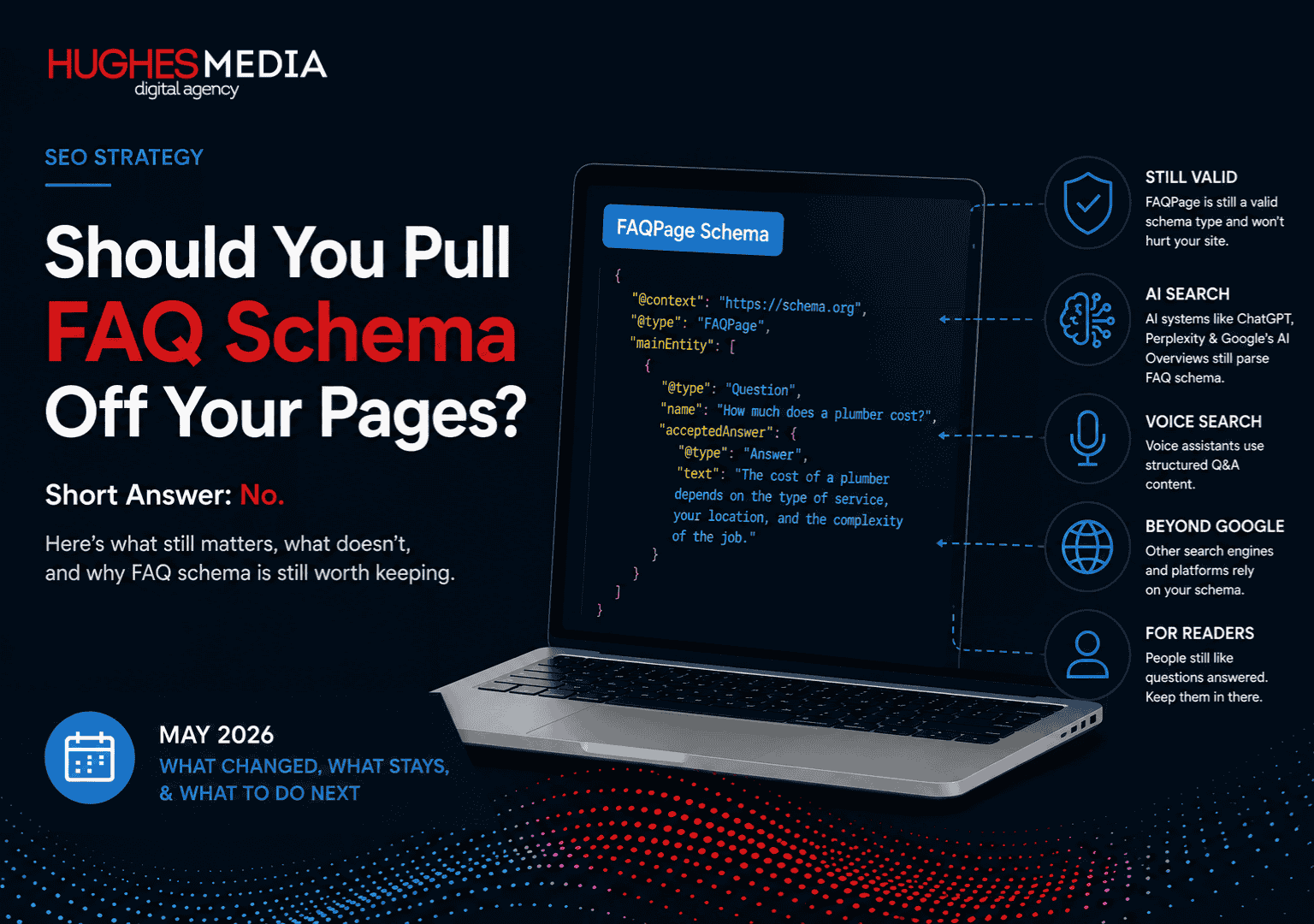
Short answer: no.
This is the part most SEO articles are getting wrong. They are either announcing “schema is dead” or claiming “FAQ schema matters more than ever for AI search.” Neither is fully accurate.
Here is the Hughes Media honest take:
- FAQPage is still a valid schema type. Leaving it in place will not hurt your site.
- AI search systems like ChatGPT, Perplexity, and Google’s own AI Overviews still parse FAQ schema. Clean, structured Q and A content is exactly what these systems pull from.
- Voice assistants and other search engines also use FAQ schema. Google is not the only place your customers look anymore.
- The only reason to remove FAQ schema is if the FAQ content itself is outdated, low quality, or no longer accurate.
- People still like questions answered, leave them in there for readers who have more questions.
For most Hughes Media clients, the FAQ blocks already on the page are doing real work. We are leaving them alone and refocusing energy on the new opportunities below.
Other Recent Google Changes Worth Knowing
The FAQ removal is not the only thing that happened this spring. Three other updates are shifting the search landscape right now.
March 2026 Core Update
Google’s first big ranking update of the year rolled out from March 27 to April 8, 2026. About 45 percent of sites saw some kind of ranking movement during the rollout, according to public tracking data.
The pattern from the update is clear:
- Sites with real authors, real photos, and clear expertise gained ground.
- Sites built on spam AI content, expired domains, or pure link tricks lost visibility.
- Brand signals (people searching for you by name, mentions on real sites, reviews) carried more weight than before.
February 2026 Discover Core Update
On February 5, Google updated the system that decides which articles show up in Google Discover, the feed on mobile devices. If you have ever wondered why one blog post brings a flood of mobile traffic and another gets nothing, this is the system that picks. The February update rewards original reporting, real perspective, and content that does not look or sound like every other AI-written piece on the topic.
AI Mode and AI Overviews Got Bigger
On May 6, 2026, Google rolled out a major expansion of AI Mode and AI Overviews. The update added more space inside the AI answers for original web content, outside sources, and firsthand perspectives. Google’s stated goal is to bridge the gap between the AI summary at the top of the page and the real websites underneath.
What that means in practice:
- AI Overviews now appear on a much wider range of questions
- Click-through rates on basic informational queries are dropping (the answer is right there on the results page)
- The opportunity is to be the source the AI cites, not just the link below it
If you want to be the answer Google’s AI pulls from, you need content that is clear, structured, and backed by real expertise. That is exactly the kind of work we have been doing for clients all year.
How to Get Started With Post-FAQ SEO
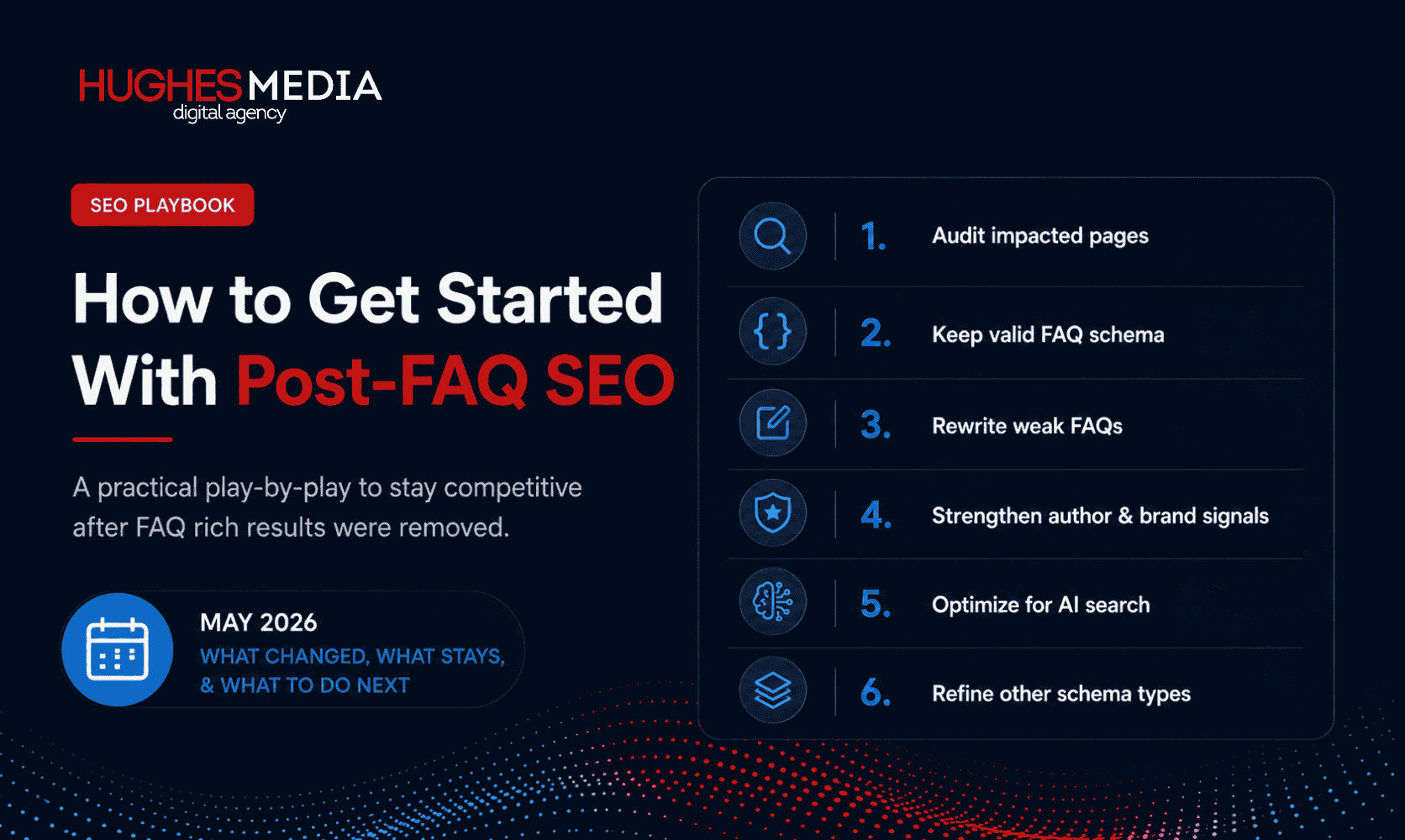
Here is the practical play-by-play for site owners who used FAQ schema and want to stay competitive.
- Audit which pages depended on FAQ rich results. Pull a list of pages where FAQ snippets were earning clicks. Those pages may see a small dip in click-through rate and need other improvements to make up the ground.
- Leave valid FAQ schema in place. Do not have your developer rip out working FAQ markup. It still helps AI search and other engines parse your content.
- Rewrite weak FAQs for human readers. If the FAQ section on the page was stuffed with keyword-heavy questions nobody asks, rewrite it. Match real “People Also Ask” questions from Google.
- Strengthen author and brand signals. Add real author bios. Include credentials, certifications, years in business, and proof of expertise inside the content itself.
- Optimize for AI search. Use clear headings, short paragraphs, structured tables, and direct answers near the top of the page. That is what AI Overviews like to quote.
- Add or refine other schema types. Article, Product, Service, LocalBusiness, and Organization schema all still earn rich features in search. FAQ is gone, but the rest are alive and well.
When to Reach Out About a Google Algorithm Issue
If any of the following sound familiar, it is time to talk:
- Your traffic dropped during the March 2026 core update and has not recovered
- Your FAQ sections were earning a meaningful share of your clicks
- You are not sure whether AI Overviews are pulling from your content
- You added schema years ago and nobody has touched it since
- You want a second opinion on what your current SEO partner is doing
Frequently Asked Questions about Frequently Asked Questions (See we are keeping them!)
When did Google remove FAQ rich results?
Google stopped showing FAQ rich results in search on May 7, 2026. Search Console reporting and the Rich Results Test will stop supporting FAQ in June 2026, and Search Console API support ends in August 2026.
Is FAQ schema dead?
No. FAQPage is still a valid Schema.org type. Google only turned off the visual rich result, not the markup itself. AI search tools, voice search, and other engines can still read and use it.
Should I remove FAQ schema from my pages?
Not in most cases. Leaving valid FAQ schema in place will not hurt your site, and it may still help AI search systems pull clean answers from your content. Only remove it if the FAQ content itself is low quality or no longer accurate.
What should businesses do right now after these Google changes?
Audit pages that depended on FAQ rich results for clicks, keep valid FAQ schema in place, strengthen E-E-A-T signals like author bios and credentials, and make sure your content directly answers the questions your customers are searching.
Call Hughes Media at 404.848.0487 or contact our team online to start the conversation.
About the Author:

Deedra Hughes
Experienced President with a demonstrated history of working in the marketing and advertising industry. Skilled in Digital Strategy, Search Engine Optimization (SEO), Integrated Marketing, Advertising, and Pay Per Click (PPC). Strong business development professional with a Bachelor’s Degree focused in Communications from Ohio University.