

By Jason Pollak, SEO Lead
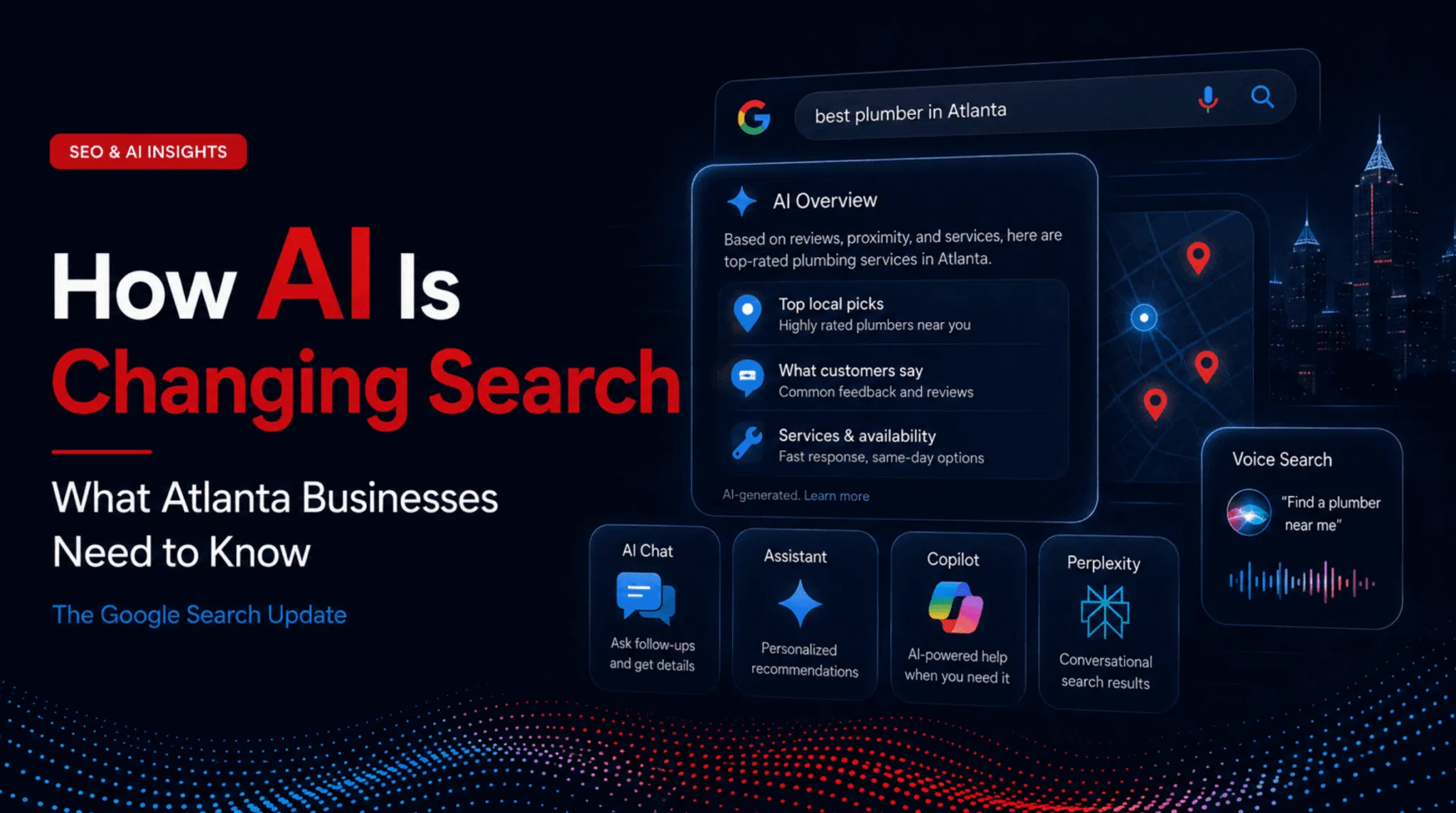
The way people find businesses is changing faster than it has at any point since Google launched. Your customers are no longer just typing keywords into a search box.
They are asking ChatGPT, Gemini, Copilot, and Perplexity full questions, in text and out loud, and getting one direct answer instead of a page of ten blue links. Google has rebuilt Search around those AI answers, and Apple is wiring LLMs into Siri.
Behind every one of those answers, an AI is deciding which businesses to recommend. Here is how AI is changing search and what it means for yours.
In this guide, we will break down:
- The Google Search changes announced at I/O 2026, straight from Google’s official announcements
- Why Apple’s partnership with Google puts Gemini in front of every iPhone user
- How people actually talk to AI tools in text and voice, and why it looks nothing like typing keywords
- Why query search now matters as much as keyword search
- How automated AI visibility research keeps your brand in the conversation
The Search Index Behind Every AI Tool
Before anything else, here is the most useful fact in AI search right now: every major AI tool grounds its real-time answers in an existing search index.
| AI tool | Search index it relies on |
|---|---|
| Google Gemini, AI Overviews, AI Mode | Google Search |
| ChatGPT Search | Bing, plus OpenAI’s own crawler |
| Microsoft Copilot | Bing |
| Perplexity | Own index, plus Bing and Google |
| Claude | Brave Search |
| Siri AI (Apple) | Gemini-based Apple Foundation Models, plus the user’s chosen AI model in iOS 27 |
Google’s Biggest Search Upgrade in 25 Years
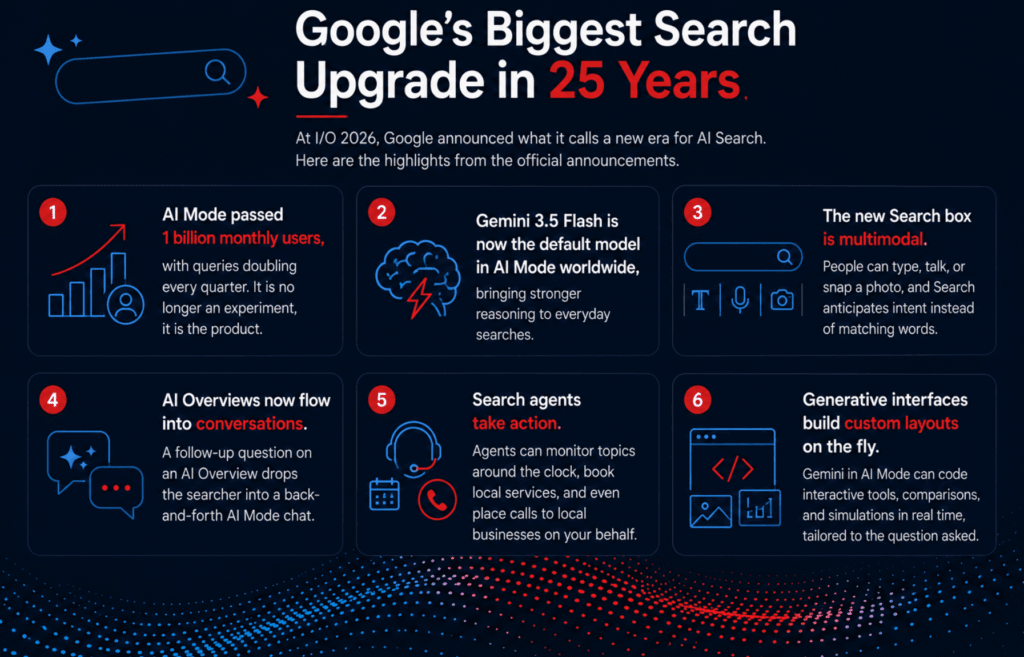
At I/O 2026, Google announced what it calls a new era for AI Search. In Google’s own words, this is the biggest upgrade to the Search box in over 25 years. The highlights from the official announcements:
- AI Mode passed 1 billion monthly users, with queries doubling every quarter. It is no longer an experiment, it is the product.
- Gemini 3.5 Flash is now the default model in AI Mode worldwide, bringing stronger reasoning to everyday searches.
- The new Search box is multimodal. People can type, talk, or snap a photo, and Search anticipates intent instead of matching words.
- AI Overviews now flow into conversations. A follow-up question on an AI Overview drops the searcher into a back-and-forth AI Mode chat.
- Search agents take action. Agents can monitor topics around the clock, book local services, and even place calls to local businesses on a searcher’s behalf. For an Atlanta service business, the next lead from Sandy Springs or Decatur may arrive as a phone call placed by Google’s agent, not a website click.
- Generative interfaces build custom layouts on the fly. Gemini in AI Mode can code interactive tools, comparisons, and simulations in real time, tailored to the question asked.
The practical impact: the familiar results have not disappeared. The links and listings are still on the page, there is simply an AI layer sitting on top of them now. Your customers see a synthesized answer first, then keep reading the regular results beneath it, often more carefully than before. The businesses cited inside the AI answer, and the listings clear enough to hold up under that closer read, win the click, the call, or the booking. Our SEO and AEO services are built around earning both.
Apple Is Putting Gemini, and Your Choice of AI, Behind Siri
In January 2026, Apple and Google released a joint statement announcing a multi-year collaboration: the next generation of Apple Foundation Models will be built on Google’s Gemini models and cloud technology. Those models power Apple Intelligence features, including the more personal Siri rolling out this year.
In June 2026, Apple officially introduced Siri AI, a far more capable assistant with richer answers, natural conversations, a dedicated app, and visual intelligence built into the iPhone camera.
Just as important: Apple is opening the gates. With iOS 27, users will be able to choose from rival AI models to power Siri and other Apple Intelligence features. ChatGPT is no longer the only third-party option. OpenAI’s ChatGPT, Anthropic’s Claude, Perplexity, and Google’s Gemini can all plug in through AI extensions, so users can effectively pick whichever AI they prefer to answer their questions.
What this means for your business is simple. Hundreds of millions of iPhone users are about to talk to an assistant powered by the same class of models that drive AI search. If your brand is not visible to the major AI models, you are not visible on the device in your customer’s pocket.
People Talk to AI Like a Person, Not a Search Box
For two decades, people compressed their needs into three or four keywords because that is what the search box rewarded. AI flipped that. People talk to LLMs the way they talk to a person.
- In a recent Stella Rising study of 524 active LLM users, only one in five wrote a short, keyword-style query. Sixty percent phrased their prompt as a full question, and most prompts ran between 6 and 30 words.
- Voice pushes this even further. Spoken queries are longer and more conversational than typed ones, and they usually lead with question words like how, why, and what. With Siri AI answering by voice, the response is often a single recommendation, not a results page. Voice also skews heavily local, the quick questions people ask from a car on I-285 or between stops around the Perimeter.
- Reading behavior changed too, and the links did not go away. An 846,000-search behavior study found that when an AI Overview appears, people stay on the results page longer, cover more of it, and keep reading the traditional listings underneath. Among searchers who reverse direction, nearly half of their scrolling on AI Overview pages goes back up to revisit and compare results. Your listing may get multiple looks instead of one, so title tags and meta descriptions now face scrutiny, not just discovery.
The takeaway: the unit of search is no longer the keyword. It is the question, asked in plain language, by text or by voice.
From Keyword Search to Query Search
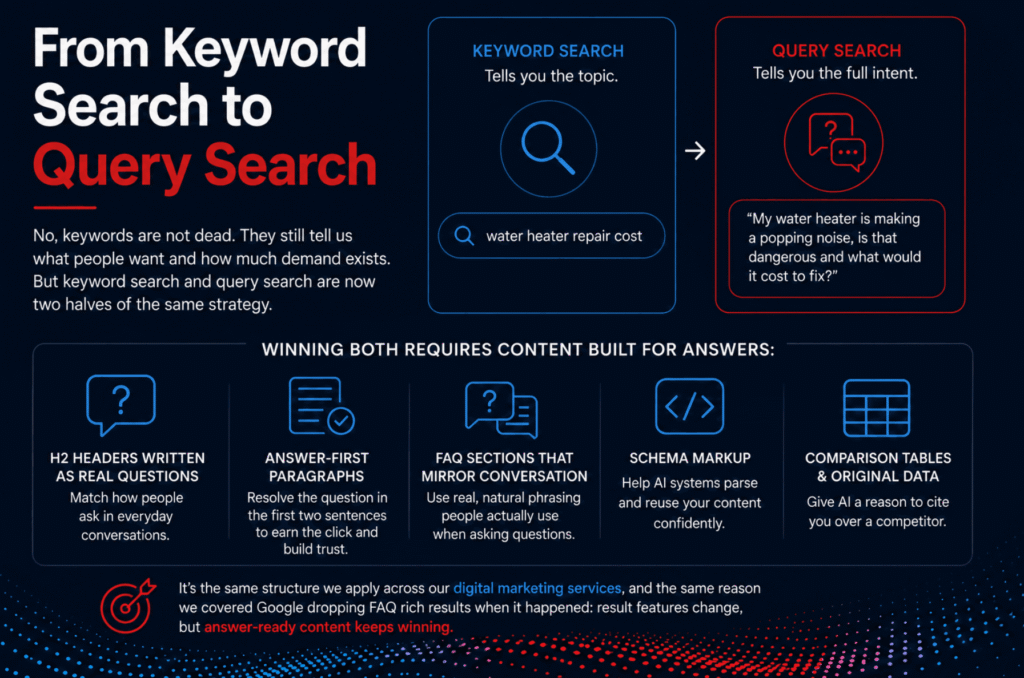
No, keywords are not dead. They still tell us what people want and how much demand exists. But keyword search and query search are now two halves of the same strategy.
- Keyword search tells you the topic:
water heater repair cost - Query search tells you the full intent: “My water heater is making a popping noise, is that dangerous and what would it cost to fix?”
Winning both requires content built for answers:
- H2 headers written as real questions, matching how people ask
- Answer-first paragraphs that resolve the question in the first two sentences
- FAQ sections that mirror actual conversational phrasing
- Schema markup so AI systems can parse and reuse your content confidently
- Comparison tables and original data that give AI a reason to cite you over a competitor
It is the same structure we apply across our digital marketing services, and the same reason we covered Google dropping FAQ rich results when it happened: result features change, but answer-ready content keeps winning.
Behind the Scenes: Our Automated AI Visibility Research
Reading announcements is not enough, so we built monitoring system. Hughes Media runs automated research scripts that query the major AI tools for the search terms that matter to each client, then record which businesses get cited, recommended, and ranked in the responses. Repeating those runs on a schedule shows us exactly how a brand’s AI visibility moves over time, across Google, ChatGPT, Copilot, Perplexity, and more.
We pair that with rank tracking, Google Search Console data, and AI visibility tracking in our SEO toolset. And we test everything on our own brand first, so client strategies are based on what we have verified, not what we have read.
What This Means for Atlanta Businesses
If you run a local business here, this shift will reach your customers early. Metro Atlanta is a tech-forward market of more than 6 million people, and with Google running one of its own engineering hubs in Midtown, new search features tend to roll out and get adopted here fast. That means the way Atlantans find a plumber, a dentist, or a marketing partner is already changing, even if your competitors have not noticed yet.
That cuts both ways for local businesses:
- Searches like “best waterproofing company in Marietta” now return an AI answer that names two or three companies, not a page of ten listings. Either you are one of the names, or you are invisible.
- Google’s agentic booking and calling features are aimed squarely at local service businesses, the backbone of the metro Atlanta economy.
- A strong Google Business Profile, consistent reviews, and locally relevant content now feed AI answers directly, whether your customers are in Buckhead, Smyrna, or Alpharetta.
The metro area also sprawls across dozens of cities and counties, so AI assistants lean heavily on location signals to decide which businesses to recommend. If your service area pages and local schema are thin, the AI guesses, and it usually guesses a competitor.
The First-Mover Advantage in AI Search
- AI answers cite a handful of sources per question. The earlier you earn those citations, the harder you are to displace.
- Most local and B2B competitors have not optimized for AI search yet. The space is wide open right now.
- Referral traffic from AI assistants is growing fast, and early studies show those visitors engage and convert at strong rates.
- Apple’s Siri AI rollout puts conversational answers on every iPhone this year. The audience is arriving before most businesses are ready.
Why Atlanta Businesses Trust Hughes Media
- Founded in 2000, with a 20+ person team of specialists covering SEO, AEO, SEM, website design, and social media under one roof
- Certified Google Partner, national UpCity Excellence Award winner, and top-rated on Expertise.com
- Clients stay with us an average of 8 years, against an industry average of about 1
- Proprietary AI visibility auditing that shows exactly how AI tools talk about your brand today
- Strategies grounded in official Google and Apple announcements and verified through our own testing
When you call, you get a clear picture of where you stand in AI search and a prioritized plan to improve it, not a generic checklist.
Frequently Asked Questions
Will AI search replace traditional Google results?
No. The traditional links and listings are still on the page; AI answers simply add a new layer on top of them. Behavior data shows searchers read the AI answer, then study the regular results even more carefully, so businesses need to win both the AI citation and the listing beneath it.
How do I get my business mentioned by ChatGPT or Gemini?
Every AI tool leans on an underlying search index, so strong rankings in Google and Bing are still the foundation. From there, structured data, consistent reviews and citations, and answer-first content increase your odds of being cited and recommended.
How can my Atlanta business prepare for AI search?
Start with an AI visibility audit to see whether tools like ChatGPT, Gemini, and Copilot mention your business today. Hughes Media runs these audits for Atlanta businesses and builds a roadmap covering content, schema, reviews, and Bing visibility.
Ready to Win AI Search?
Hughes Media is a full-service digital marketing agency founded in 2000, serving local and B2B clients across Metro Atlanta and nationwide.
We track every official announcement behind this shift so you do not have to, and we combine proven SEO with proprietary AI visibility research to keep your brand cited, recommended, and found.
Request an AI visibility audit, schedule a discovery call, or call us at 404-848-0487. Proudly serving Metro Atlanta and clients nationwide.
About the Author:

Jason Pollak
Jason Pollak is the SEO Lead for Hughes Media. He is a full-funnel marketing strategist with over 12 years of experience in SEO, paid media, and digital strategy. He has helped brands across local services, eCommerce, B2B, and SaaS grow their online presence and drive measurable revenue. His work spans local search optimization, paid campaigns, and conversion strategy.