

If you pay for Google Ads and SEO, it makes sense to ask how each serves your budget. In the accounts we manage, they matter equally, and we run a keyword plan for both. Every keyword in that plan goes into one of two groups: searches the site already ranks for, and valuable searches it does not rank for yet. Ads can cover both groups, and in one recent month, a B2B manufacturer we run this plan for got 29 leads from organic search and 23 from Google Ads.
Hughes Media is an Atlanta-based digital marketing agency that has helped businesses grow online since 2002. We are a certified Google Partner with experience managing more than $300,000 per month in PPC spend, and we handle SEO, landing pages, and lead tracking for the same clients.
What You Will Learn About PPC and SEO
Each section below covers one part of the plan, using examples from a B2B manufacturer and a home services company we work with. Client names are left out.
- How we split keywords between ads and SEO content
- How we launch ads on the same schedule as new blog posts
- How we adjust ads once a page starts ranking
- How ad data decides what we change on your website
- How we count and report leads from both
Quick Summary: How We Run PPC and SEO Together
| Step | What We Do | Why We Do It |
|---|---|---|
| Split keywords into two groups | Run ads on searches your site already ranks for, and on valuable searches it does not rank for yet | A ranking post already matches the search, and ads cover the gaps while our writers build content |
| Launch ads with new posts | Turn on the matching ad group, or switch its landing page to the new post, the week the post goes live | New content starts getting ad traffic right away |
| Graduate ranking keywords | Lower the maximum bid by 10 to 15% once a post holds a top five ranking for 30 days | As rankings grow, budget moves to campaigns for buyers who are ready to reach out |
| Use ad data on your website | Update the pages the ads use based on which links and searches bring in leads | Your pages lead with what buyers respond to, like reviews and real job photos |
| Count real leads | Bid on actions like form fills and calls over 60 seconds, and report ad and organic leads side by side | Budget decisions are based on leads, not clicks or page views |
How We Split Keywords Between Ads and SEO
We call our approach a two-pronged keyword strategy. The first prong is searches where a client’s blog content already ranks. We run ads on those too, so the business shows up in the ads and the organic results at the same time, and the ad sends clicks to the post that ranks. Because that post already matches the search, we expect these keywords to hold a Quality Score of at least 7 out of 10, and we check it every Wednesday.
The second prong is valuable searches the site does not rank for yet. Ads cover the most valuable of those from day one, sending clicks to the closest service or industry page until our writers publish a post for that search. A separate group for quote-ready searches stays on no matter which posts are live.
Both prongs share one negative keyword list that blocks searches from DIY shoppers, retail buyers, and job seekers. We review the searches that triggered the ads the week before and add the irrelevant ones to that list. Strong new searches get added to the plan, tagged by whether we already have content for them, and the ones without content become candidates for the next content sprint. We also pull new keywords from regular reviews of competitors’ blogs.
How We Launch Ads With Each New Blog Post
Our content plan runs in sprints, and we match each post in a sprint to an ad group ahead of time. The week a post goes live, its ad group turns on with the post as the landing page, or switches to it if the group was already running. Ad groups for topics in later sprints stay paused until their posts are published. For the manufacturer, the first sprint paired ad groups with blog posts on product specs, competitor comparisons, customer case studies, and one in-depth guide.
Our web team requests indexing in Google Search Console as soon as a post is live, and our SEO team checks its indexing, impressions, and rankings within 48 to 72 hours. On the ads side, we watch the new ad group’s Quality Score for its first seven days. One of the manufacturer’s articles went from 18 to 79 Google clicks in a single month, and the number of times it appeared in search results grew from 1,370 to 5,834.
How Ad Data Shapes Your Website
For a home services company, three months of ad data showed that the Reviews link under its ads brought in leads at $46 each, compared with $81 for the Service Areas link. That told us buyers in this market want proof before they call. So the refresh of the pages the ads send clicks to focuses on proof, with real job photos, clearer headlines, and stronger calls to action. The company’s new campaign is being built with real before-and-after job photos only.
The same data showed that searches with a city name in them cost more per lead than searches for the service itself. So we paused the city ad groups, and the service ads reach people in those cities through location targeting instead. The new campaign’s ads are set up to insert the searcher’s city into the ad text. On the SEO side, the plan builds out the company’s city pages, starting with its two main services, so the company can also show up for city searches in the organic results.
How We Count and Report Leads From Both
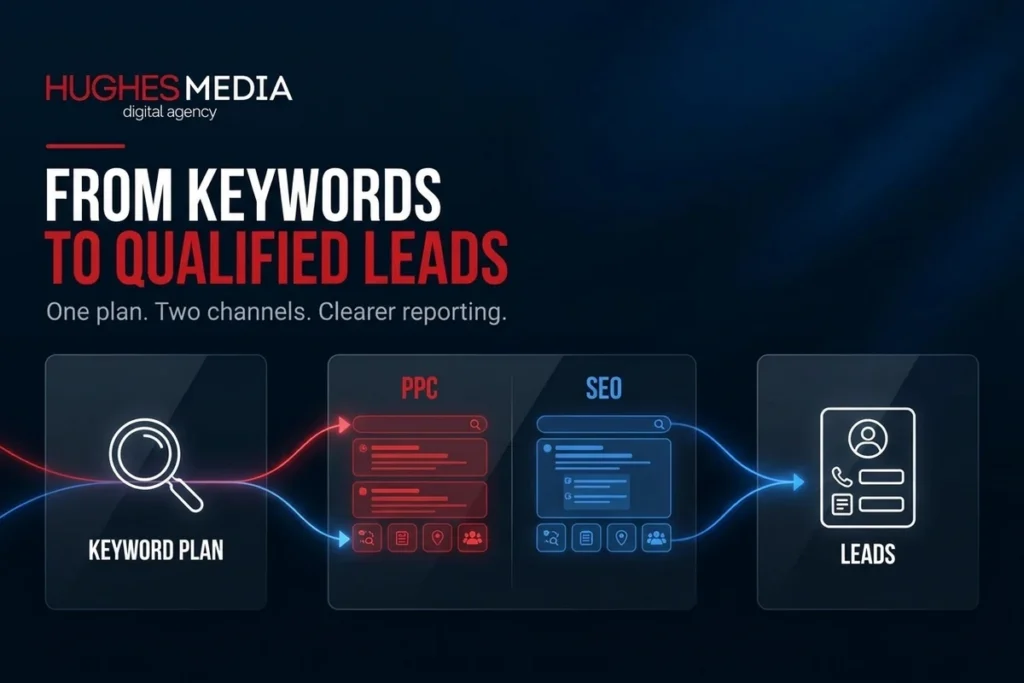
Before we launch a campaign or raise its budget, we choose which actions Google Ads should bid toward. For the manufacturer, that is completed forms, since its buyers contact the company through forms. For the home services company, it is form submissions and calls longer than 60 seconds. Page views, clicks for directions, and newsletter signups still show in reports, but they do not steer bidding.
When a client’s CRM is connected to Google Ads, we set it up to send leads the sales team marks as qualified back to Google Ads, matched to the ad click that brought them in. Those stay in reports only until there are about 15 to 20 a month, and then we let Google Ads bid toward them. Once deal amounts come through as well, we switch to bidding on lead value, so a keyword that brings in two large deals gets more budget than one that brings in ten form fills that never become sales.
Every monthly report shows ad leads and organic leads side by side, with repeat contacts and internal calls removed, plus how often Google’s AI Overviews cite the site. In September, the AI Overview for one of the manufacturer’s specialty product searches cited its website on 28 of 30 days. We explain how we write content for AI search in how AI SEO drives more leads.
Why Businesses Choose Hughes Media for PPC and SEO
Our SEO writers and PPC specialists sit on the same team and work from the same keyword plan. That is why an ad group can switch to a new post the week it goes live, and why page updates the ad data calls for do not wait on another vendor. When a client books jobs through scheduling software, we connect it to Google Ads so the campaigns can see which leads turned into booked jobs.
Our clients stay with us for eight years on average, even without long-term contracts. Clients own their ad accounts and everything we create, and they can reach Deedra Hughes, our president, directly. For more of our ad results, our B2B PPC case study shows how we cut one client’s cost per conversion by 47%.
Frequently Asked Questions
Do I need separate landing pages for PPC and SEO?
Not for every search. Ads on searches can go to the same blog post that ranks organically, but ads on quote-ready searches go to a quote or consultation page with a form. When it is unclear which page will bring in more leads for a keyword, we test the blog post against a product page and compare the form fills from each.
How long does it take to see results from PPC and SEO?
We run the first campaign for about a month so every ad group builds up click data. In month two or three, we add a second campaign built around the keywords that performed best, set up to bring in form fills rather than traffic. On the SEO side, a B2B manufacturer we work with saw a new guide reach the first page of Google for its main search in the same month it went live.
Should I start with SEO or PPC if my budget only covers one?
If you can only fund one, we would start with ads on quote-ready searches, the ones from people looking to request a quote or book a service. Those buyers are ready to reach out even if your site has no blog content on the topic yet. The searches that trigger those ads also show us which topics to write about first once SEO fits the budget.
Should I bid on my business name if I already rank first?
Searches for your business name work differently from the other searches you rank for, because the people making them are already looking for you. We run ads on your name at launch until they reach about 200 clicks, which gives us enough visitor data to start building audience lists for follow-up ads. After that, if your site holds the top organic spot for your name, we pause the name ads and move that budget to ads for people who visited your site but have not contacted you yet.
Get More Leads From PPC and SEO
Our process starts with a call and a strategy session. We will sort your current keywords into the two prongs, show where your ads and content already overlap, and map out your first content sprint with the ad groups that go with it. Hughes Media works with businesses in Atlanta and across the country, so contact our team or call 404.848.0487 to get started.
About the Author:

Deedra Hughes
Experienced President with a demonstrated history of working in the marketing and advertising industry. Skilled in Digital Strategy, Search Engine Optimization (SEO), Integrated Marketing, Advertising, and Pay Per Click (PPC). Strong business development professional with a Bachelor’s Degree focused in Communications from Ohio University.