

By the Hughes Media Team
If you are running Google Ads for a B2B company, you have probably asked some version of this question: Are we spending too much for each lead?
When cost per conversion climbs, many teams assume they need a bigger budget. In reality, the fastest path to lower PPC costs is usually not more spending. It is better tracking, tighter targeting, and disciplined optimization.
Hughes Media is an Atlanta-based digital marketing agency that has helped businesses grow online since 2002. We are a certified Google Partner, and we manage paid media alongside SEO and conversion strategy so clients get measurable lead growth, not just traffic.
We also structure our work around the same principles that make long-term agency partnerships work: transparent reporting, client ownership (you keep what we build), and flexible engagement options without long-term contracts.
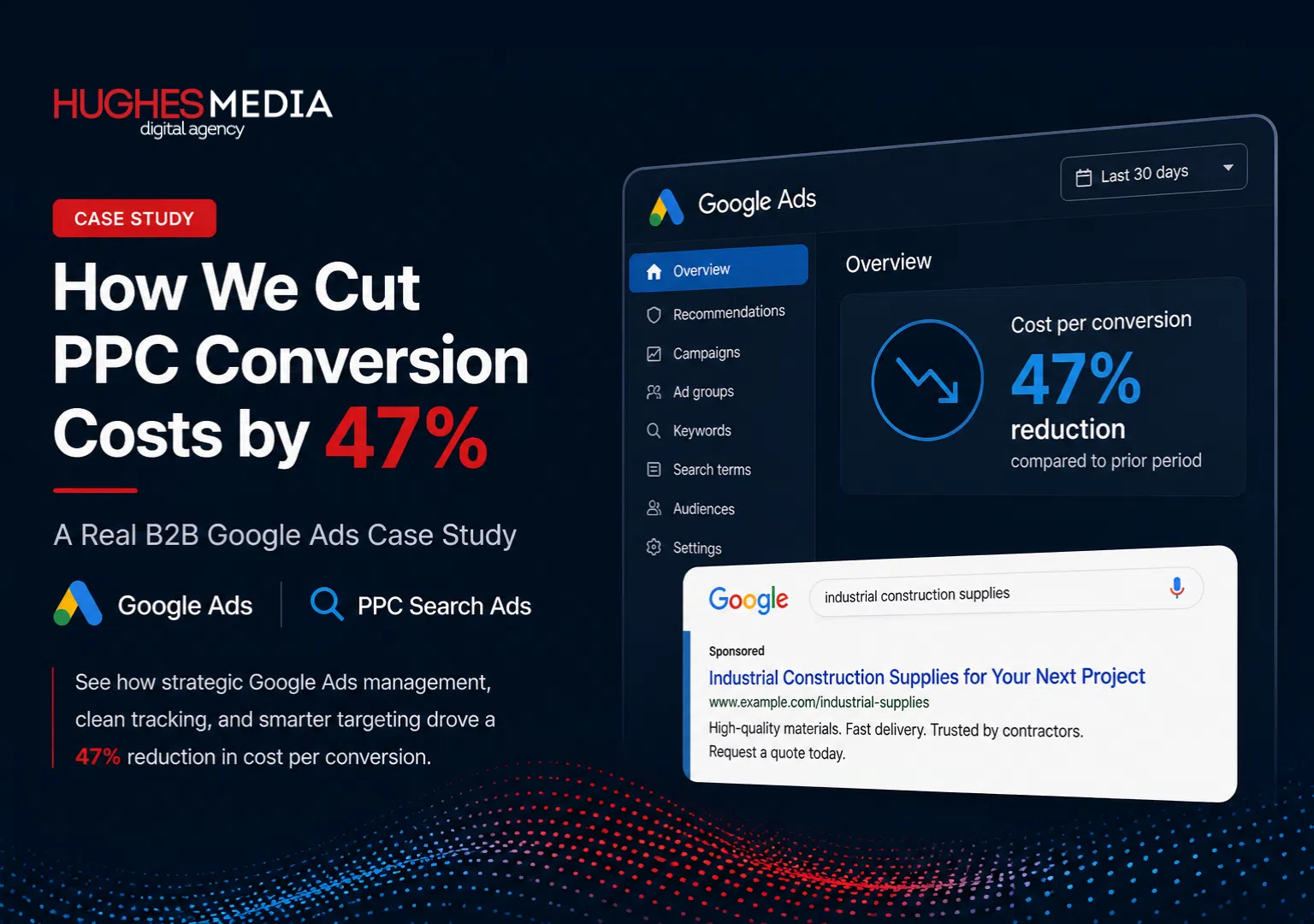
In this case study, we helped a B2B client reduce PPC costs by 47% per conversion by rebuilding their tracking foundation, cleaning up campaign structure, and focusing spend on the regions and searches that actually produced qualified leads.
What You Will Learn
- Why inaccurate conversion tracking inflates your PPC costs and hides real performance
- The Google Ads optimizations that most often reduce cost per conversion in B2B accounts
- How Google Tag Manager helps you track leads cleanly and make smarter decisions
- How to use regional targeting to cut wasted spend and improve lead quality
- A practical checklist you can use to reduce PPC costs in your own account
Quick Summary Table: What Changed and Why It Worked
| Change | What it fixed | Why it lowers cost per conversion | Best for |
|---|---|---|---|
| Conversion tracking rebuild (GTM + GA4 + Ads) | Missing, duplicated, or misattributed conversions | Stops bidding decisions from being based on bad data | B2B lead gen forms and calls |
| Search terms cleanup + negative keywords | Irrelevant clicks and research-only searches | Improves intent match and raises conversion rate | High CPC industries |
| Regional targeting and location controls | Spend outside serviceable territory | Reduces wasted budget on out-of-area leads | Suppliers and contractors with defined territories |
| Landing page alignment by ad group | Message mismatch and low Quality Score | Raises Quality Score and conversion rate over time | B2B products with multiple applications |
1. The Problem: Rising PPC Costs With Diminishing Returns
This client is a B2B supplier serving commercial construction and industrial builds. Their PPC account was spending consistently, but results were trending the wrong direction.
Common symptoms included:
- Lead volume was inconsistent from week to week
- Cost per conversion kept rising
- The team could not confidently separate high-quality leads from low-quality leads
- Campaign reporting did not match what the sales team saw in the pipeline
In B2B, these problems compound fast. One unqualified lead can still cost the same click budget as a qualified one. If conversion tracking is not clean, the account can optimize toward the wrong signals.
Why Businesses Hire Hughes Media for PPC
Before we get into the tactical changes, here is the context that matters to business owners comparing agencies.
Certified Google Partner with real paid media scale
We actively manage pay-per-click campaigns for clients across Atlanta and nationwide. The day-to-day work is grounded in the fundamentals that drive results in paid search: clean conversion tracking, tight search intent control, and landing page alignment.
No long-term contracts and no smoke and mirrors
We offer project-based work and ongoing retainers. Either way, the goal is the same: clear performance reporting, clear ownership of the work, and a strategy you can understand.
Built for lead generation
Our PPC process is designed around the actions that matter in B2B: qualified form leads, calls, and sales conversations.
2. What We Changed: A Strategic Approach to Google Ads Management
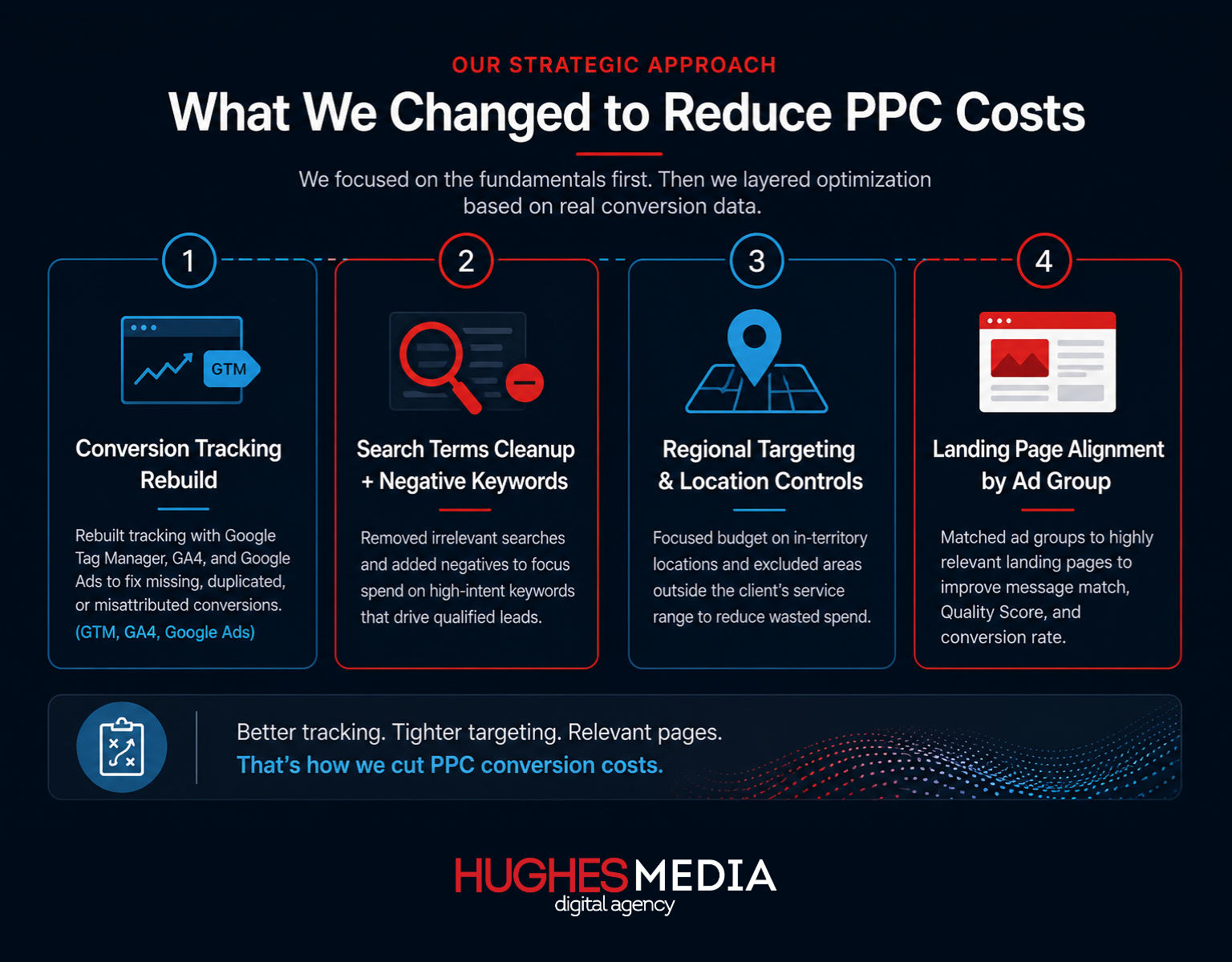
To reduce PPC costs, we focused on the fundamentals first. Then we layered in optimization based on real conversion data.
Step 1: Fix conversion tracking first (GTM, GA4, and Google Ads)
If you want to reduce PPC costs, you need to know exactly what counts as a conversion.
For most B2B construction suppliers, the highest value conversion actions are:
- Quote request form submissions
- Contact form submissions
- Calls from the website
- Calls from Google Ads call extensions (if phone is a primary CTA)
What we implemented (high level):
- Defined primary conversions vs. secondary conversions
- Set up consistent tracking using Google Tag Manager
- Verified that conversions were firing once per action, not multiple times
- Confirmed attribution and linking across Google Ads and GA4
Learn more about Hughes Media PPC services on the pay per click page.
Step 2: Clean up search intent and eliminate wasted clicks
After tracking was stable, we reviewed search terms and performance by keyword theme.
In many B2B accounts, wasted spend comes from searches that sound relevant but are not purchase-intent. Examples include:
- DIY or consumer intent
- Job searches
- Product definitions and research-only queries
- Out-of-territory or out-of-service searches
Actions we took:
- Tightened match types (shifted away from broad where it was bleeding budget)
- Built a negative keyword system that grew weekly
- Split ad groups by true intent so budgets could be controlled
Step 3: Use regional targeting to focus budget where the client can win
For B2B suppliers, the buying journey is often regional. Even when a company can ship nationally, there are still regions where:
- Install partners exist
- Sales coverage is strongest
- Projects are more common
- Lead quality is higher
We refined:
- Location targeting settings
- Bid adjustments by region (when data supported it)
- Ad copy language to match regional qualifiers and service coverage
Step 4: Improve landing page alignment and conversion path
You can have a strong campaign and still pay too much per lead if the landing page is not aligned.
We reviewed:
- Message match from keyword to ad copy to landing page
- Call to action clarity
- Form friction (fields, errors, mobile usability)
- Page speed basics
Learn more about Hughes Media Lead Generation services on the Lead Generation page.
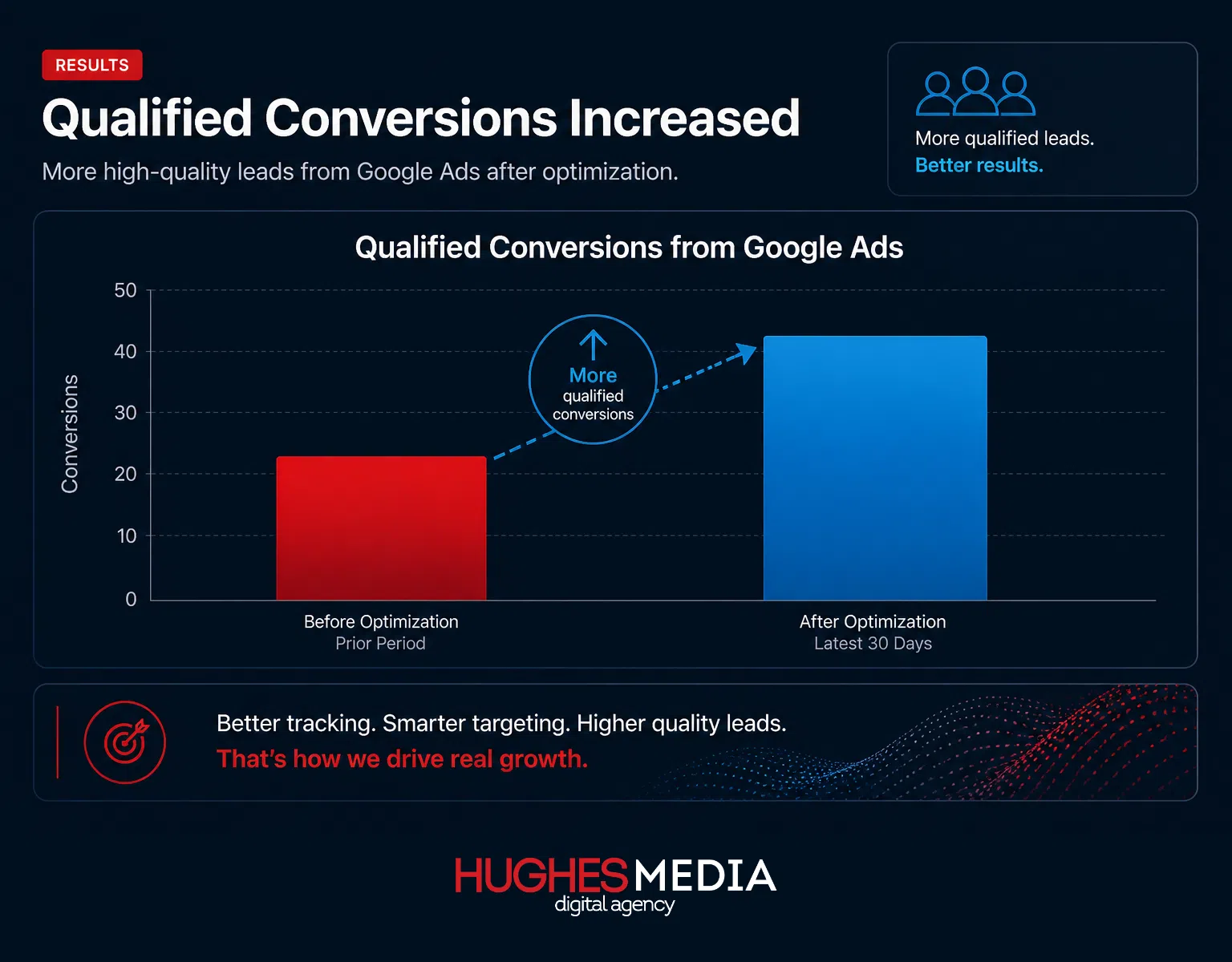
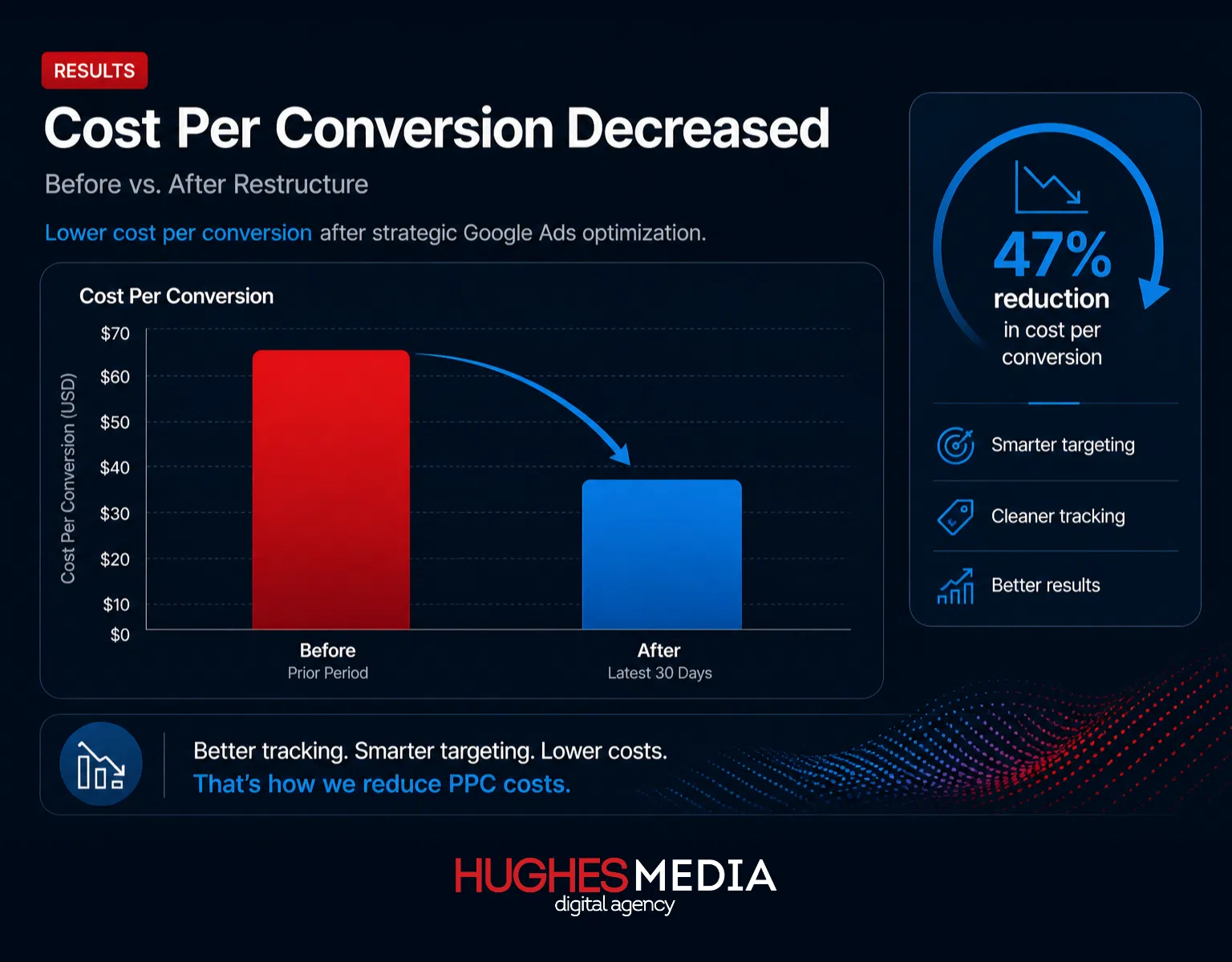
3. The Results: 47% Reduction in Cost Per Conversion
After implementing tracking fixes and rolling through weekly optimizations, the account stabilized and then improved. We also updated the ads with fresh site links, headlines, CTAs, and optimized the ad schedule.
Outcome: Cost per conversion decreased by 47%.
4. Key Takeaways for Any B2B Business Running Google Ads
These are the principles that apply across almost every B2B Google Ads account.
Clean conversion tracking makes every other optimization work
If conversion tracking is wrong, bidding strategies and optimizations will be wrong. Fix tracking first.
Negative keywords are not optional
A growing negative keyword list is one of the biggest levers for reducing PPC costs.
Regional focus usually beats broad reach
If your sales coverage and service capability is not truly national, do not pay for national traffic.
The landing page is part of your PPC budget
If your page does not convert, your clicks get more expensive over time.
5. Why PPC Management Matters More Than PPC Spending
Two businesses can spend the same amount on Google Ads and get completely different outcomes.
The difference is almost always:
- Measurement and conversion tracking
- Campaign structure and keyword strategy
- Ongoing search terms and negative keyword discipline
- Landing page alignment and conversion rate optimization
If your account has not been audited recently, you might be leaving qualified leads on the table while paying for clicks that never had a chance to convert.
6. FAQs About Reducing PPC Costs
How do I reduce PPC costs without cutting my budget?
The best approach is to reduce wasted spend first. Tighten targeting, add negative keywords, and fix conversion tracking so you can shift budget to what converts.
Why is my cost per conversion so high on Google Ads?
Common causes include broad match waste, weak negative keyword coverage, poor landing page alignment, and inaccurate conversion tracking. Any one of these can inflate your costs.
Does Google Tag Manager help reduce PPC costs?
Yes. Google Tag Manager makes it easier to track form submissions, calls, and other lead actions accurately. Better tracking leads to better decisions, which lowers cost per conversion over time.
Should B2B companies use regional targeting in Google Ads?
In many cases, yes. Regional targeting helps prevent wasted spend outside your serviceable territory and can improve lead quality.
How long does it take to lower PPC costs?
Some improvements happen quickly, like removing irrelevant search terms. Others, like Quality Score and conversion rate improvements, take weeks of consistent optimization.
7. Closing CTA
If you are trying to reduce PPC costs and you are not sure what is driving your high cost per conversion, a professional audit is the fastest way to get clarity.
Here is the simplest next step:
- Quick discovery call
- Conversion tracking and account audit
- Clear action plan to lower wasted spend and improve lead quality
Hughes Media is an Atlanta-based digital marketing agency that has been helping businesses grow online since 2000. Clients get direct access to founder and CEO Deedra plus a team built for lead generation across PPC, SEO, and conversion strategy. The average client partnership lasts 8 years. Hughes Media has also helped businesses grow online visibility by up to 400 percent and increase leads by 600 percent in a single year for one client. We focus on long-term partnerships, transparent reporting, and client ownership so you always know what is working and why.
Request a free PPC audit from Hughes Media.
Call today: 404 848 0487
About the Author:

Deedra Hughes
Experienced President with a demonstrated history of working in the marketing and advertising industry. Skilled in Digital Strategy, Search Engine Optimization (SEO), Integrated Marketing, Advertising, and Pay Per Click (PPC). Strong business development professional with a Bachelor’s Degree focused in Communications from Ohio University.