

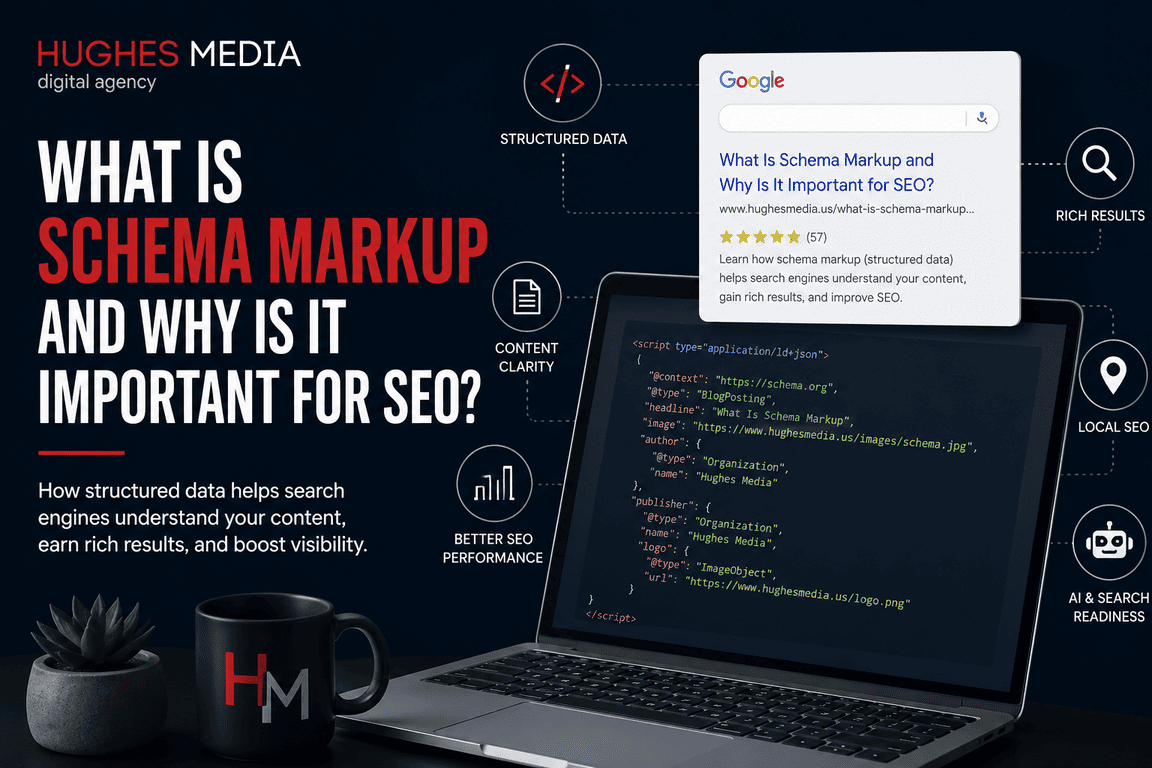
Schema markup is structured data that helps search engines understand what a webpage represents. It identifies important details such as the page type, business, author, service, product, location, review, question, or breadcrumb path instead of leaving a crawler to infer every relationship from the visible copy.
For schema SEO, the goal is not to add as many markup types as possible. The goal is to describe the page accurately, connect it to the correct business or publisher entity, and support the search features for which the content is genuinely eligible.
Hughes Media uses schema across service pages, local business websites, blog posts, product content, case studies, and technical SEO projects. That experience includes deciding what belongs sitewide, what belongs on one page, how entities should connect through stable identifiers, and how to prevent plugins and manually added code from producing conflicting markup.
What You Will Learn About Schema SEO
- What schema markup communicates to search engines and other systems that process webpages
- Which schema types fit articles, FAQs, local businesses, organizations, services, and products
- How structured data supports rich-result eligibility, entity clarity, and AI search readiness without guaranteeing visibility
- How to plan, implement, validate, and maintain JSON-LD without duplicating markup
Schema Types at a Glance
The right schema depends on the page’s purpose and visible content. A page should use the most specific, accurate type, not every type that appears relevant to the broader website.
| Schema Type | Best Used For | What It Defines | Implementation Note |
|---|---|---|---|
| Article or BlogPosting | Blog posts, guides, news, and educational content | Headline, author, publisher, image, dates, and article topic | Update dateModified after a substantial content refresh |
| FAQPage | Pages with visible question-and-answer content | The relationship between each visible question and its answer | Schema text should match the page content |
| LocalBusiness | Local companies, storefronts, and service-area businesses | Business type, name, address, phone, hours, and service area | Use the most specific valid business subtype and avoid duplicate business entities |
| Organization | Company identity on the homepage or About page | Brand name, URL, logo, profiles, and organization identity | Reference the same organization@idfrom publisher and provider properties |
| Product | Pages focused on one product or variants of that product | Product name, brand, image, identifiers, attributes, offers, and availability | Do not treat a general category or product listing as one Product |
| Service | Service pages and lead-generation landing pages | Service name, provider, category, offer, and area served | Connect the provider to the established business or organization@id |
| BreadcrumbList | Most indexable pages | The page’s position within the website hierarchy | Match the actual navigational path and canonical URLs |
What Is Schema Markup?
Schema markup is a standardized vocabulary for describing the entities and information on a webpage. The vocabulary comes from Schema.org, while search engines publish additional requirements for specific search features.
A visitor can usually recognize a company name, service, author, product, price, review, or question from the design and surrounding copy. Structured data labels those details explicitly so a machine can identify what each item is and how it relates to the page.
The most common implementation format is JSON-LD. It sits inside a script block and does not change the visible design. This makes it easier to manage than older inline microdata, but the markup still needs to match what visitors can see and what the business can support.
What Is Schema SEO?
Schema SEO is the practice of planning and maintaining structured data as part of a broader search strategy. It supports page classification, entity consistency, eligible search features, local business clarity, and cleaner connections between content and the organization that published it.
Schema does not replace relevant copy, keyword research services, internal linking, backlinks, crawlability, or technical performance. It adds an explicit machine-readable layer to content that should already be useful and accurate.
A strong schema strategy also distinguishes between the Schema.org vocabulary and Google’s search-feature requirements. A property can be valid at Schema.org without making the page eligible for a Google rich result. Likewise, a technically valid block can still be misleading if it describes content that is hidden, outdated, or absent from the page.
Why Schema Markup Matters for SEO
Search engines evaluate more than keyword matches. They identify entities, page types, relationships, and context. Schema can reinforce that a page is an article published by a particular organization, a service offered by a local business, or a product manufactured by a specific company.
Certain supported schema types can also make a page eligible for enhanced search presentations. Eligibility does not guarantee that Google will display a rich result, but accurate markup gives the page the technical foundation required for supported features.
Schema is especially useful when a website contains similar names, multiple locations, many services, or several plugins generating overlapping data. Consistent @id values and accurate page-level markup help keep those entities connected instead of creating several disconnected versions of the same business, author, or product.
For Hughes Media, schema works alongside SEO services rather than as a separate shortcut. The visible content establishes relevance and usefulness. Structured data clarifies how that content should be classified and connected.
How Schema Markup Supports AI Search
Google states that websites do not need additional markup or special optimization to appear in AI Overviews or AI Mode. Schema should therefore not be presented as a direct AI citation factor or a guarantee of inclusion.
Structured data can still make page entities and relationships more explicit to systems that process web content. It may clarify who published an article, which organization provides a service, where a business operates, or which product a page describes. How individual search and AI platforms use that markup varies.
The strongest AI-ready pages combine crawlable visible content with direct answers, clear headings, useful tables, consistent facts, and accurate structured data. Schema supports that foundation, but it does not replace the content or the broader authority signals used to select sources.
How to Use Common Schema Types
Article and BlogPosting Schema
Article or BlogPosting schema identifies editorial content and its publisher. A useful implementation includes the headline, author, publisher, featured image, canonical page URL, publication date, and modified date. The author and publisher should link to stable Person or Organization entities when those entities exist elsewhere on the site.
Substantially rewritten posts should receive an accurate dateModified. Changing the date without meaningful content updates can misrepresent freshness, while leaving an old modified date on a thoroughly refreshed post hides useful context from search engines.
FAQPage Schema
FAQPage schema describes question-and-answer content that is visible to users. The question names and answer text should match the page, and the markup should be updated whenever the visible FAQ changes.
The purpose is to describe useful Q&A accurately, not to create extra keyword variations or add answers that visitors cannot find. Visible questions should solve real decision, comparison, suitability, process, or pre-purchase needs.
LocalBusiness Schema
LocalBusiness schema defines the company’s real-world business identity. It can include the most specific valid business subtype, address, phone number, hours, service area, logo, profiles, and location details.
The implementation should avoid generating a separate version of the same business on every page. Many sites establish the business entity once at the site or location level, then connect page-specific Service, Article, or WebPage markup to its stable @id. This separation supports cleaner local SEO services and reduces conflicting business data.
Organization Schema
Organization schema defines the brand or company that publishes content and provides services. Google recommends placing the primary organization information on the homepage or a single organization-focused page, such as About.
Other schema blocks can reference that entity instead of recreating it. For example, Article markup can identify the publisher with https://www.example.com/#organization, while Service markup can use the same identifier for the provider. That creates one connected entity rather than several unrelated organization objects.
Product Schema
Product schema should describe a specific product or variants of the same product. It can include the product name, image, brand, manufacturer, SKU or other identifier, attributes, and supported offer information.
Google’s product rich-result guidance focuses on pages dedicated to one product or its variants. A general product category or listing should not be represented as one Product. Depending on the page, a category may be better described with WebPage, CollectionPage, ItemList, and BreadcrumbList markup.
Pricing, ratings, availability, and reviews should only be included when they are accurate and supported by the page. A Schema.org-valid Product block is not automatically eligible for Google’s product search features.
Service Schema
Service schema defines an offering such as SEO, PPC management, plumbing repair, dog training, or commercial installation. It can connect the service to its provider, service area, category, and relevant offer information.
A service page still needs clear visible copy that explains what is provided. Schema should label the offering, not attempt to supply an invisible replacement for thin content.
BreadcrumbList Schema
BreadcrumbList schema communicates where a page sits within the site hierarchy. Each ListItem should use the correct position, name, and canonical URL.
The path should match the website structure. A blog post might use Home → Blog → Article Title, while a service page might use Home → Services → Service Name. Broken, redirected, or invented breadcrumb URLs weaken the implementation.
Anonymized Examples From Hughes Media Client Work
Schema strategy changes with the page type, business model, and markup the website already generates. These examples come from Hughes Media client work, with identifying brand details removed.
Connecting a local-service article to the correct business entity
For a regional plumbing company, Hughes Media paired Article and BreadcrumbList markup with visible FAQPage content and the specific Plumber business type. The publisher and business markup shared a stable organization @id, helping connect the educational article to the company responsible for the content without relying on a generic LocalBusiness label.
This example shows why schema types should describe both the page and the real entity behind it. The Article defines the editorial content, the Plumber entity defines the business, and the breadcrumb path places the article within the website.
Preventing duplicate business entities on a multi-location website
For a multi-location flooring retailer, Hughes Media established one sitewide FlooringStore entity and removed duplicate LocalBusiness blocks from individual page implementations. Location and service pages retained only the page-specific WebPage, FAQPage, and BreadcrumbList markup they needed.
This created a cleaner separation between permanent business information and content that changes from page to page. It also reduced the risk of conflicting names, addresses, hours, ratings, or organization identifiers appearing across the site.
Connecting a B2B case study to a specific product
For a building-products manufacturer, Hughes Media connected Article, Product, Organization, and BreadcrumbList markup on a technical case study. Stable @id references linked the case study to the manufacturer, while the Product entity described the specific product featured in the project.
This relationship helps distinguish the editorial case study from the manufacturer and product it discusses. It is an example of semantic entity modeling, not a claim that the case study will qualify for a Google Product rich result.
Step-by-Step Schema Implementation Guide
Schema implementation should begin with an audit, not a copied template. The following process helps prevent invalid, duplicated, or misleading structured data.
1. Audit the markup already being generated. Test the live URL in the Google Rich Results Test and Schema Markup Validator, inspect the page source, and check what the CMS, theme, and SEO plugins already output. A second manual block can create duplicates even when each block looks valid on its own.
2. Separate sitewide entities from page-specific markup. Establish the main Organization or LocalBusiness entity at the appropriate site or location level. Use Article, Service, Product, FAQPage, WebPage, and BreadcrumbList only where the individual page supports them.
3. Match schema to visible content and page intent. Choose the type that describes the page itself. Do not add reviews, prices, availability, FAQs, or business details that are hidden, outdated, or unsupported.
4. Choose one implementation method for each schema type. A WordPress plugin can manage common Article, Organization, and Breadcrumb markup, while custom JSON-LD may be useful for specialized Service or Product relationships. If Rank Math already generates Article markup, do not paste a second Article block without disabling or reconciling the first.
5. Connect entities with stable @id values. Use one durable identifier for each organization, author, webpage, article, service, or product. Reference those identifiers from related blocks so the structured data forms a connected graph.
6. Add the properties that apply to the page. Follow Schema.org for vocabulary and the relevant search engine documentation for feature-specific requirements. Include recommended properties when they are accurate, but do not invent values simply to remove a warning.
7. Validate, publish, and monitor the live page. The Schema Markup Validator checks vocabulary and syntax, while the Rich Results Test evaluates supported Google search features. Test the final public URL after publishing, then monitor Search Console and recheck the markup when content, plugins, products, or business details change.
Simple Schema Markup Example
This simplified BlogPosting example connects the article to a consistent publisher entity:
<script type="application/ld+json">
{
  "@context": "https://schema.org",
  "@type": "BlogPosting",
  "@id": "https://www.hughesmedia.us/what-is-schema-markup-why-is-it-important-for-seo/#article",
  "headline": "Schema SEO: What Is Schema Markup and Why Does It Matter?",
  "description": "Learn what schema markup is, how schema SEO supports rich results and entity clarity, and how Hughes Media implements structured data for clients.",
  "image": "INSERT FEATURED IMAGE URL HERE WHEN PUBLISHING",
  "author": {
    "@id": "https://www.hughesmedia.us/#organization"
  },
  "publisher": {
    "@id": "https://www.hughesmedia.us/#organization"
  },
  "datePublished": "INSERT DATE HERE WHEN PUBLISHING",
  "dateModified": "INSERT DATE HERE WHEN PUBLISHING",
  "mainEntityOfPage": {
    "@type": "WebPage",
    "@id": "https://www.hughesmedia.us/what-is-schema-markup-why-is-it-important-for-seo/"
  }
}
</script>
A production implementation should also confirm that the referenced Organization entity is present, the featured image URL is live, and the dates match the published article.
Common Schema Markup Mistakes to Avoid
- Adding markup for information that users cannot see or the business cannot verify
- Allowing a theme, SEO plugin, and manual code block to generate duplicate versions of the same entity
- Treating a product category or general listing as one Product
- Using an invalid or overly broad schema type when a supported accurate type is available
- Adding unsupported ratings, reviews, prices, or availability
- Changing company names, URLs, or
@idvalues between pages - Assuming a Schema.org validation result guarantees a Google rich result
- Failing to update schema after a major content, product, location, or business change
Does Schema Markup Improve Rankings?
Schema markup is not generally treated as a direct ranking factor in the same way that relevance, authority, links, or technical accessibility can influence visibility. It should not be sold as a shortcut to higher positions.
Its practical value is clearer page classification, stronger entity consistency, and eligibility for supported search features. Those benefits can improve how a search engine processes and presents a page when the content and the rest of the website are strong.
The useful question is not whether schema creates an automatic ranking increase. It is whether the markup accurately removes ambiguity and supports the search experience the page is eligible to receive.
Is FAQ Schema Still Worth Using?
FAQPage schema remains useful when it accurately matches visible question-and-answer content. Google rarely displays FAQ rich results for most commercial websites, but that search-display policy is separate from how search engines and AI systems process structured Q&A.
The visible questions and answers remain the primary source. FAQPage markup adds an explicit machine-readable relationship between each question and answer, which can support clearer interpretation by systems that process the page.
The markup does not guarantee extraction, citation, or AI visibility. Use it because the page contains useful question-and-answer content, not simply to chase a search feature.
How Hughes Media Approaches Schema SEO
Hughes Media starts by auditing what the website already produces. WordPress themes and SEO plugins often generate Organization, Article, Breadcrumb, or WebSite markup automatically, so adding custom JSON-LD without checking the source can create unnecessary duplication.
We then separate stable entity information from page-specific details. The business or organization receives a consistent @id, while each article, service, product, FAQ section, and breadcrumb path describes only the content supported by that page.
Schema is most effective when it works with strong visible content, accurate business information, internal links, and a maintainable publishing process. Our goal is not to maximize the number of schema blocks. It is to create structured data that remains accurate, connected, and useful as the website evolves.
FAQ About Schema SEO
What is schema markup in SEO?
Schema markup is structured data added to a webpage’s code to help search engines understand the meaning of the content. It can identify details like the page type, business name, services, products, FAQs, author, publisher, and breadcrumb path.
What is schema SEO?
Schema SEO is the practice of using structured data to improve how search engines and AI systems understand a website. It supports rich result eligibility, entity clarity, local SEO, content classification, and AI search readiness.
Does schema markup help with AI Overviews?
Schema markup can help AI Overviews and answer engines by making important information easier to parse and understand. It does not guarantee an AI citation, but it supports machine readability when paired with strong, answer-focused content.
What types of schema should most websites use?
Most websites should consider Organization or LocalBusiness schema, WebSite schema, BreadcrumbList schema, and page-specific schema such as Article, Service, Product, or FAQPage. The right mix depends on the page type and visible content.
What is the difference between Article schema and FAQ schema?
Article schema identifies a blog post, guide, or editorial page, including details like headline, author, publisher, and date. FAQ schema identifies a visible list of questions and answers on the page.
Can I add schema markup myself?
You can add schema markup yourself if you understand JSON-LD, Schema.org requirements, and validation tools. However, a professional SEO team can help choose the right schema types, avoid errors, and connect schema to a broader search strategy.
How do I know if my schema markup is working?
You can test schema with the Google Rich Results Test and the Schema Markup Validator. After publishing, monitor Google Search Console, page indexing, impressions, click-through rate, and whether the page becomes eligible for supported rich results.
Get Help With Schema SEO
Schema markup helps search engines and other systems understand a website more clearly. If your content is strong but your structured data is missing, duplicated, outdated, or incomplete, a schema SEO update can strengthen the site’s technical foundation.
Hughes Media helps businesses plan structured data for service pages, local business websites, blog posts, product pages, and broader search-readiness projects. To improve your schema markup and SEO strategy, contact Hughes Media or call 404-848-0487.
Last updated on August 12, 2026
About the Author:

Deedra Hughes
Experienced President with a demonstrated history of working in the marketing and advertising industry. Skilled in Digital Strategy, Search Engine Optimization (SEO), Integrated Marketing, Advertising, and Pay Per Click (PPC). Strong business development professional with a Bachelor’s Degree focused in Communications from Ohio University.