

A B2B manufacturer came to Hughes Media with a website that generated almost no organic leads. Their Google Ads campaigns were running, but costs kept climbing and the leads that came through were inconsistent. After we rebuilt their content system with AI SEO strategies at the center, the results were immediate.
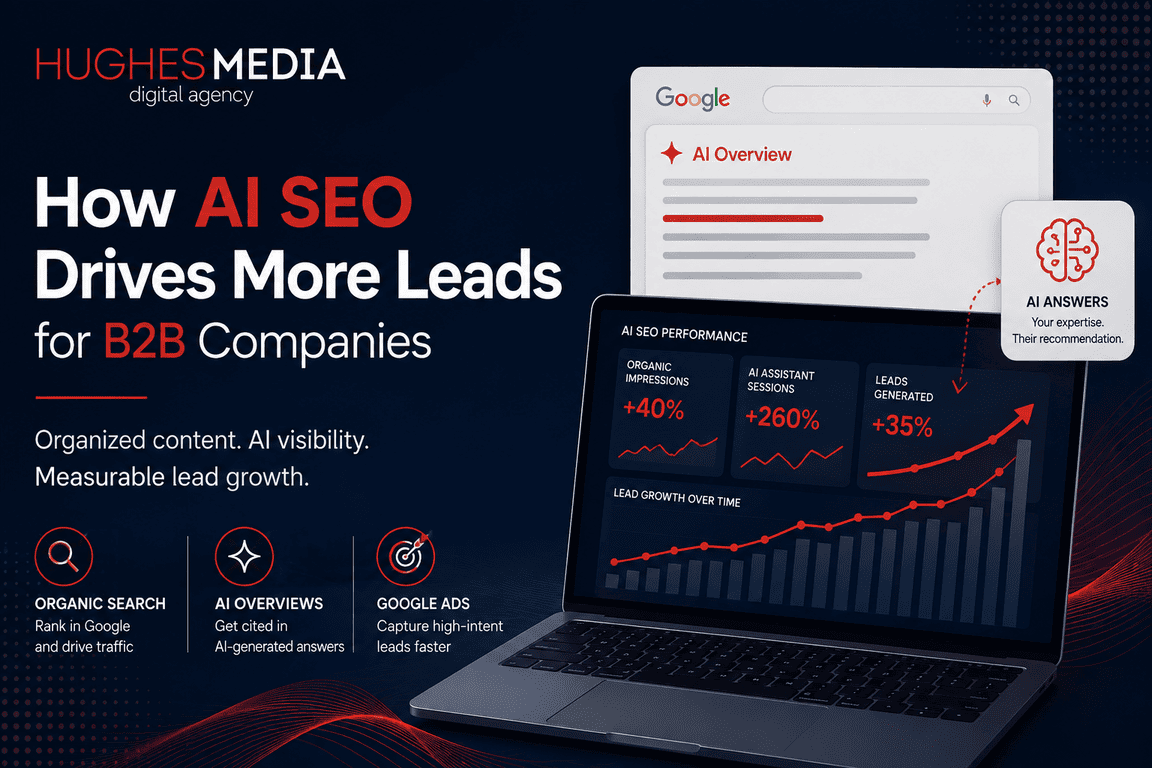
Over three months, organic search clicks grew over 20% while impressions jumped over 40%. Traffic from AI assistants like ChatGPT, Claude, and Gemini surged 260%. We were also able to drive more conversions and leads from Google Ads without increasing their spend by optimizing keywords and ad copy. The average cost per click dropped by over 6%, while lead quality improved.
Those results did not happen by accident. As an Atlanta digital marketing agency that has been building search strategies since 2000, Hughes Media has navigated every major shift in search, from keywords and metadata to schema, mobile-first indexing, and now AI. We are a Google Partner with experience managing over $300,000 per month in PPC spend. That depth of experience is why we announced that AI search visibility would be integrated into every SEO engagement, not offered as a separate add-on.
The point is simple. AI SEO is not a buzzword. It is a system that produces measurable leads for B2B companies when it is built on organized data, real expertise, and the right technical foundation. Here is how it works and why it matters now.
What You Will Learn About AI SEO:
- How AI SEO generates qualified leads from organic search, AI Overviews, and Google Ads working together
- The real numbers behind a B2B manufacturing client that saw search impressions climb over 40% and AI assistant sessions jump from 10 to 36 in a single month
- Why organized content and schema are the foundation that feeds every search channel
- How to evaluate whether your business is visible in AI search results or invisible to buyers
Where B2B Leads Come From in an AI Search World
| Lead Channel | What It Does | Lead Quality | Time to Results |
|---|---|---|---|
| Organic Search (SEO) | Ranks your pages in Google’s traditional results | High: searchers are actively looking | 3 to 6 months |
| AI Overviews (AEO) | Gets your content cited in Google’s AI-generated answers | High: AI recommends you as the answer | 3 to 6 months |
| Google Ads (PPC) | Places your site at the top of search results immediately | Medium to High: depends on targeting | Immediate |
What AI SEO Actually Does for Lead Generation
AI SEO is the practice of optimizing your website so that both traditional search engines and AI answer engines can find, understand, and recommend your business. Some call it answer engine optimization, or AEO. Others call it generative engine optimization (GEO). The label matters less than the system. It builds on the SEO fundamentals that have always mattered, like keyword targeting, site speed, and clean HTML. It adds a new layer of organized content, schema markup that LLMs can read, and answer-ready passages that AI tools like ChatGPT, Google AI Overviews, and Perplexity can parse and cite.
AI SEO does not replace traditional SEO. It expands it. Traditional SEO gets you into the blue links. AI SEO gets you into the AI-generated answers that now appear above those links. When a procurement manager asks ChatGPT for a recommendation on insulated metal panels for cold storage, the AI pulls from sources it trusts. If your content is not built for that, you are invisible in that conversation, even if you rank on page one.
The impact on lead generation is direct. We have seen it in our own data. Hughes Media’s website now appears in 129 AI Overview link-presence signals and receives traffic from ChatGPT, Gemini, and Copilot. Those are real visitors who found us through AI-generated answers, not traditional search results. The same system we built for ourselves is what we build for clients.
The B2B Manufacturing Case Study
Here is the real example. A B2B manufacturer approached Hughes Media with a common problem: their website generated almost no organic leads, and their Google Ads campaigns were producing inconsistent results at a rising cost. They had a product that buyers actively searched for, but their content was thin, their schema was missing, and their site structure did not give search engines or AI tools anything to work with.
We rebuilt the system from the ground up. First, we used custom scraping scripts to audit the full website, down to the HTML, and identify every technical issue, content gap, and structural problem. Then we built an organized client knowledge base that connected their product data, service capabilities, industry applications, customer questions, and competitive positioning through linked databases. Every piece of content we created afterward drew from that connected data.
The results came in layers. Google Search Console clicks rose from 454 to 553, a 21.8% increase, while impressions climbed to nearly 45,000. The products page more than doubled its clicks from 26 to 60, and the cold storage industry page more than doubled from 17 to 37. One new blog post generated 18 clicks and over 1,300 impressions in its first month alone. AI Overviews began citing their content for non-branded industry queries, with the client appearing in the top mention position for key product and application searches. AI assistant sessions jumped from 10 to 36, with ChatGPT alone sending 28 visits. Google Ads campaigns were rebuilt with proper conversion tracking and tightly themed ad groups. By July, the campaign was generating more clicks on lower ad spend, while average CPC improved by nearly 7%.
This is not a one-channel win. It is the result of SEO, AEO, and PPC working from the same unified foundation.
Read more of our case studies here.
How Organic Search and AI Overviews Work Together
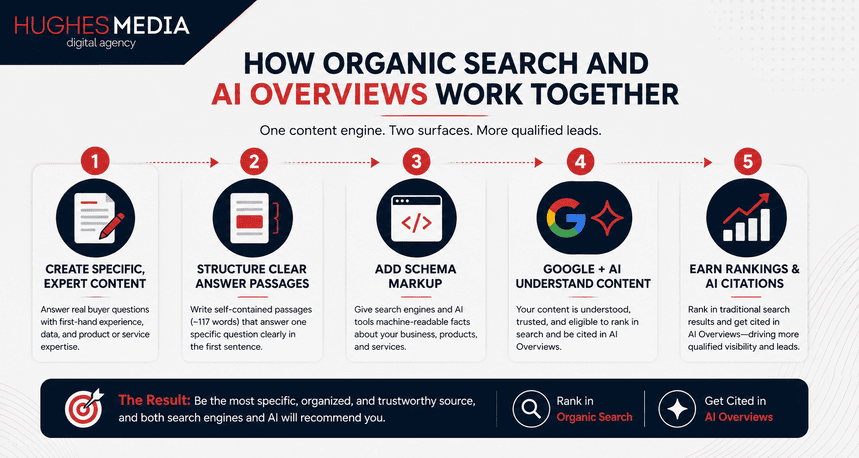
Organic search and AI Overviews are not competing channels. They are two surfaces fed by the same content engine. When you publish a well-structured article that answers a specific buyer question with real expertise, it can rank in traditional search results and get cited in AI-generated answers at the same time.
The key is passage-level optimization. Google’s AI Mode and other answer engines often prioritize the first 150 words that directly provide an answer to a question. If your content is structured, has clear, self-contained passages that answer buyer questions in the first sentence and support that answer with specific details, those passages become the raw material AI tools recycle across dozens of related queries.
We wrote about this in detail in our guide on how AI is changing search. The short version is that the businesses that earn AI citations are the ones with the most specific, verifiable, well-structured data. Generic content does not get cited. Content built on real product specs, real customer questions, and real service data does. If you want to know how to rank in ChatGPT, this is the answer. Be the most specific, organized source on the topic.
Schema markup for AI search plays a critical role here. Schema gives search engines and AI tools machine-readable facts about your business, products, and services. Without it, AI systems have to guess what your content means. With it, they can confidently cite your business as the answer. This is how to get featured in AI Overviews. Give the machines structured data they can trust. Even after Google removed FAQ rich results, the structured data behind those FAQs still feeds AI answer engines.
Why Google Ads Still Matter in an AI Search World
Some agencies pitch AI SEO as a replacement for paid advertising. That is wrong. Google Ads and AI SEO work best when they run side by side, each filling gaps the other cannot.
Google Ads gives you immediate visibility while your organic content builds authority. For a B2B manufacturer launching a new product line, paid ads can generate leads on day one while the blog posts and industry pages that will eventually rank organically are still being written and indexed. Data from those campaigns, including which keywords convert, which landing pages perform, and which audiences produce qualified leads, also informs the organic content strategy.
We documented this in our B2B PPC case study, where we cut PPC conversion costs by 47% for a B2B client by rebuilding their tracking foundation and focusing spend on the regions and searches that actually produced qualified leads. That is how to reduce cost per lead without cutting the ad budget. The same principles apply to B2B PPC strategies across the board: without proper conversion tracking and lead attribution, you are guessing.
The B2B manufacturer in our case study runs both channels. Organic search and AI Overviews produce the majority of their leads at no marginal cost, and AI assistant sessions jumped from 10 to 36 in a single month. Google Ads fills in with targeted, high-intent traffic for specific product searches and competitive terms where organic ranking will take longer. The campaign now generates more clicks at a lower average CPC, while CTR holds steady above 10%. The two channels share the same content foundation, so every landing page, every ad, and every blog post reinforces the same message.
How Connected Content Feeds Every Channel
The reason the B2B manufacturer’s program works is that every channel pulls from the same source. That source is a content system built in Notion, not a folder of disconnected documents.
The system starts with a full audit of the client’s website, competitors, and search landscape. Every product, service, industry application, customer question, and competitive differentiator gets organized into connected databases. Keywords link to topic clusters. Topic clusters link to blog drafts. Blog drafts link to published content with live URLs and schema pages. When a writer sits down to draft a new post, they are not starting from a blank page. They are pulling from verified product data, real customer questions, and competitive analysis that is already organized and searchable.
This is the same approach we described in our home services marketing knowledge base blog, and it works the same way for B2B manufacturers. The difference is the data. A home services company has service areas, emergency response, and local search intent. A B2B manufacturer has product specs, industry verticals, and procurement-stage search intent. The framework stays the same. Only the data changes.
When the content is organized, every channel benefits. Organic search gets well-optimized pages with proper keyword targeting and internal linking. AI Overviews get passage-level answers with schema-backed facts. Google Ads campaigns benefit from landing pages that match the ad copy and convert at a higher rate because the content is specific and authoritative. This is what schema-backed data and E-E-A-T optimization look like in practice. They turn your expertise into machine-readable proof. AI-driven marketing is not about the tool. It is about the data you feed it.
Watch: How AI SEO Works in Practice
Why Delaying AI Search Optimization Costs B2B Companies Leads
The B2B companies that build AI SEO foundations now are the ones that will be cited by answer engines for years. Every month you wait, competitors are publishing content that AI tools learn to trust. Once an AI system starts recommending a competitor, it takes significantly more effort to displace them than it would have taken to get there first.
The cost of inaction is not just missed traffic. It is missed conversations. When a buyer asks an AI assistant or Google’s AI Overview for a product recommendation, the AI gives one answer, not ten blue links. If your business is not in that answer, you are not in the consideration set. The buyer never visits your site, never fills out your form, never calls your sales team. You lose the lead before you know it existed.
Companies that wait also face rising Google Ads costs. As more competitors enter paid search, the cost per click goes up. Companies with strong organic and AI visibility can reduce their dependence on paid traffic and allocate budget more strategically. The companies without it are stuck paying more for the same number of leads, or fewer.
Why B2B Companies Trust Hughes Media
Hughes Media is an Atlanta digital marketing agency that has been building search strategies since 2000. The agency is a certified Google Partner with experience managing over $300,000 per month in PPC spend, and our team includes specialists across SEO, AEO, PPC, web development, and content strategy. Every client gets direct access to senior team members, not layers of account managers. We are not just an SEO agency. We are an AI marketing agency built for the way search works now.
We recently announced a full-agency commitment to AI search visibility, integrating AI search optimization into every SEO engagement rather than selling it as a separate add-on. That means every client gets schema optimization, ChatGPT monitoring, and AI visibility tracking as part of their standard SEO work. Whether you need Atlanta SEO services, lead generation for contractors, or a full AEO agency partner, the same system applies.
Our results are documented. We have increased one client’s leads by 600%, grown annual website traffic by 20 to 40% for every client, and driven a 77% year-over-year traffic increase for an HVAC company with zero paid traffic. For B2B manufacturers, we have cut PPC conversion costs by 47% and built content systems that drive measurable month-over-month growth in organic clicks, impressions, and AI assistant traffic. We use real data from Google Search Console, GA4, and rank-tracking tools, then explain the results in plain language.
When to Evaluate Your AI Search Visibility
If any of the following sound familiar, it is time to assess your AI SEO readiness:
- Your organic traffic has plateaued or declined, and you are not sure why
- You are spending more on Google Ads but getting fewer qualified leads
- You do not know whether ChatGPT, Gemini, or Google AI Overviews mention your business
- Your website has no schema markup, or the schema was added years ago, and nobody has updated it
- Your competitors are showing up in AI-generated answers, and you are not
- Your content reads as if it could apply to any company in your industry
- You have never run a full technical audit of your website
An AI search visibility audit answers these questions with data, not opinion. It tells you exactly where you stand in traditional search, where you appear in AI answers, and what to fix first. Local business AI search optimization starts with knowing where you stand. Schedule a discovery call to get started.
Frequently Asked Questions
How long does it take for AI SEO to generate leads?
Most clients see organic traffic growth within 3 to 6 months, with citations in AI Overviews beginning to appear as content is organized and indexed. Google Ads can generate leads immediately while the organic foundation builds. In the case study above, Search Console clicks rose nearly 22% in a single month while the products page more than doubled its clicks.
Does AI SEO replace Google Ads?
No. The two channels work best together. Google Ads provides immediate visibility and lead flow while organic content builds authority. Over time, organic search and AI Overviews reduce your dependence on paid traffic, which lowers your overall cost per lead. But paid ads remain valuable for competitive terms, new product launches, and targeted campaigns.
How is AI SEO different from traditional SEO?
Traditional SEO focuses on ranking in Google’s blue links. AI SEO adds a layer focused on getting your content cited by AI answer engines like ChatGPT, Google AI Overviews, and Perplexity. It uses the same fundamentals, including clean HTML, fast pages, and proper keyword targeting, but adds organized content, schema markup, and passage-level optimization so AI tools can parse and recommend your business.
What does it cost to work with Hughes Media?
Every engagement is custom-scoped based on your industry, goals, and current website condition. AI search visibility is included in every SEO engagement. Contact us for a discovery call, and we will send a price sheet based on the services you need.
Build a Lead-Generating AI SEO Strategy
AI SEO is not a future trend. It is producing leads right now for B2B companies that have built the right foundation. The system works because it relies on real data, organized content, and the technical foundation that both Google and AI answer engines require. The companies that invest in this now will own the AI-generated answers in their industry for years.
Hughes Media helps B2B companies build content systems that generate leads from organic search, AI Overviews, and Google Ads. If you want to know how to optimize for AI search, start with an audit. See our case studies or schedule a discovery call to talk about what AI search optimization could look like for your business.
For more on how AI is reshaping search, read our guide on how AI is changing search.
About the Author:

Deedra Hughes
Experienced President with a demonstrated history of working in the marketing and advertising industry. Skilled in Digital Strategy, Search Engine Optimization (SEO), Integrated Marketing, Advertising, and Pay Per Click (PPC). Strong business development professional with a Bachelor’s Degree focused in Communications from Ohio University.