

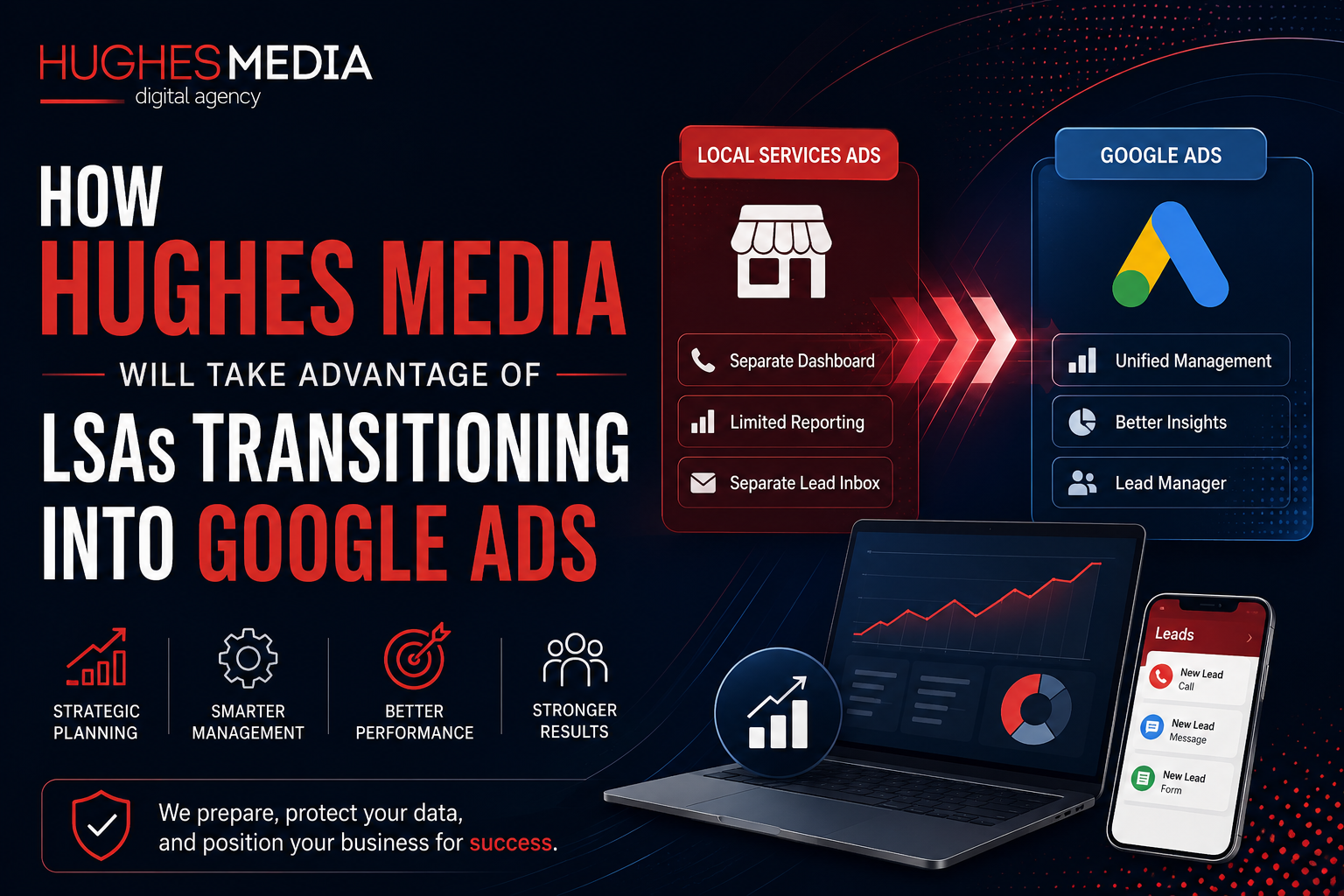
Google Is Moving Local Services Ads Into Google Ads: Is Your Data Ready?
Google is moving Local Services Ads into Google Ads, and the change is bigger than a new dashboard. Beginning in August 2026, select U.S. home and storefront service advertisers will have their existing Local Services Ads campaigns automatically migrated into specialized Performance Max campaigns built around pay-per-lead goals.
The transition should make day-to-day campaign management easier. Businesses will be able to manage Local Services Ads, budgets, targeting, and leads from the same platform they use for other Google advertising. However, Google has also confirmed that previous Local Services Ads performance reports will not move into Google Ads. Once an account migrates, the original Local Services Ads dashboard will no longer be accessible.
That reporting change is the part businesses cannot afford to overlook.
Hughes Media has managed digital marketing campaigns since 2000 and currently manages more than $300,000 per month in PPC advertising. As a Google Partner agency, we see the unified interface as a useful operational improvement. We also see it as a clear example of why historical reporting and lead attribution should never live inside one advertising platform alone.
What You Will Learn About the Local Services Ads Migration:
- What will change when Local Services Ads move into Google Ads
- Why historical LSA reports need to be downloaded before migration
- How a unified Target CPA could affect multi-service businesses
- Why independent lead tracking matters during platform changes
- How to prepare before and after Google moves your account
What Is Changing When Local Services Ads Move Into Google Ads?
Google calls the change a more integrated, self-service experience. Existing Local Services Ads campaigns will become a specialized Performance Max campaign type inside Google Ads, but they will not work like standard Performance Max campaigns.
The migrated ads will remain keywordless. They will continue appearing exclusively on Google Search and Google Maps in the same positions as before. Advertisers will still pay for valid leads, such as calls and messages, rather than clicks. The major differences involve where campaigns are managed, how budgets and bidding work, and where reports and leads are stored.
| Current LSA Setup | After Migration | Business Impact |
|---|---|---|
| Separate Local Services Ads dashboard | Managed inside Google Ads | Fewer platforms and logins |
| Average weekly budget | Average daily budget | Budget pacing needs review |
| Manual maximum cost per lead available | Manual bidding removed | Less direct bid control |
| Target CPA by service category | One campaign-level Target CPA | Service economics become more important |
| Historical reports in the LSA dashboard | Previous reports do not transfer | Reports must be backed up |
| Separate LSA lead inbox | Lead Manager inside Google Ads | Centralized lead management |
| Core business information managed separately | Name, address, and standard hours sync from Google Business Profile | Less duplicate account maintenance |
Google provides the complete timeline and feature details in its official Local Services Ads migration announcement.
One Interface Will Make Google Campaign Management Easier
Local Services Ads and standard Google Ads campaigns previously required separate dashboards, separate reporting views, and a separate lead inbox. Bringing them together removes a meaningful operational burden for businesses and agencies running more than one type of Google campaign.
After migration, advertisers will be able to review pay-per-lead campaign performance alongside other Google Ads campaigns. Lead Manager will replace the existing Local Services Ads inbox, and advertisers will be able to review charged status, lead type, customer messages, and lead feedback from within Google Ads.
Core business information will also be easier to maintain. Business names, physical addresses, and standard hours will sync from Google Business Profile. Service areas and ad schedules can still be customized for the campaign without changing the organic Business Profile.
This consolidation should make daily management faster. It does not make Google Ads a complete source of truth for the business. Google Ads can show what happened within Google advertising, but it cannot independently confirm whether a lead was qualified, booked, closed, or profitable.
Your Historical LSA Reports Will Not Follow You
Google has stated that previous Local Services Ads performance reports will not carry over to Google Ads. Once an account migrates, attempts to access the old dashboard will redirect to Google Ads, and the old reports will no longer be available.
This creates a serious problem for any business that has treated the platform dashboard as its historical record. Without independent copies, it may become difficult or impossible to compare:
- Year-over-year lead volume
- Seasonal cost-per-lead changes
- Performance by service category
- Results before and after budget changes
- Long-term location trends
- Pre-migration and post-migration campaign performance
At Hughes Media, reporting is not treated as a temporary view inside an advertising platform. We retain structured monthly reports, source exports, and CSV files in each client’s Notion hub so the business record survives platform changes. When an interface disappears, the history does not disappear with it.
That matters during routine reporting, but it matters even more during a migration. If performance shifts after the account moves, we need a reliable before picture. Without one, every explanation is based on memory or incomplete screenshots.
Why Independent Lead Tracking Matters During the Migration
Google Ads, Local Services Ads, organic search, call tracking tools, and customer relationship management systems can all count leads differently. One platform may record a call as a conversion while the sales team later determines that it was a wrong number, duplicate inquiry, existing customer, or unqualified lead.
This is why Hughes Media uses independent CRM tools, like WhatConverts, as an independent source for lead attribution. Calls and forms can be tracked across channels without relying entirely on one platform’s conversion total. The source remains visible even when campaign names, dashboards, or reporting structures change.
Independent tracking helps answer the questions that matter to the business:
- Which channel produced the inquiry?
- Which service did the person request?
- Which campaign and location generated the lead?
- Was the lead qualified?
- Did the lead turn into a booked job or sale?
- What was the potential or actual value of the customer?
A platform migration should not create a gap in this chain. If attribution is established outside the migrating dashboard, Hughes Media can compare leads before and after the transition using the same definitions.
For a real example of how clean tracking improves campaign decisions, read how Hughes Media reduced PPC cost per conversion by 47%. The campaign improved after conversion tracking was rebuilt across Google Tag Manager, GA4, and Google Ads, giving the team better data for optimization.
How Unified Target CPA Changes Multi-Service Advertising
The bidding change may have the largest strategic impact on businesses advertising more than one service.
Under the current Local Services Ads setup, an advertiser may use different Target CPA amounts for different service categories. A plumbing company that also offers HVAC services could set one target for plumbing leads and another for HVAC leads.
After migration, Google will calculate one campaign-level Target CPA across all categories in the campaign. Manual bidding and vertical-level Target CPA will no longer be supported.
The challenge is that two services can have very different economics. A plumbing repair lead may cost less and close quickly. An HVAC replacement lead may cost more to acquire but produce much more revenue. If both services share one target, the lowest-cost conversion is not automatically the most valuable conversion.
Before accepting a combined campaign structure, businesses should compare each category’s:
- Lead volume
- Cost per lead
- Qualified lead rate
- Close rate
- Average job value
- Customer lifetime value
- Seasonal demand
- Budget requirements
- Performance by geography
This is the data that shows whether a combined campaign makes sense. Without it, the structure decision is a guess.
Should You Separate Services Into Different Campaigns?
Google allows advertisers to create separate campaigns when different services need different Target CPA rules. That does not mean every service should automatically receive its own campaign.
Keeping services together can provide Google with more conversion data. This may help businesses with limited lead volume maintain stronger bidding signals. A combined campaign can work when services have similar acquisition costs, values, locations, and budget priorities.
Separate campaigns may make more sense when:
- Services have substantially different lead costs
- Close rates vary by category
- One service has a much higher average customer value
- Different services require separate budgets
- Geographic targets differ
- One category consumes the budget without producing comparable revenue
- Each category has enough conversion volume to support independent optimization
Hughes Media segments performance by service, budget, and geography before recommending a structure. We can model a combined campaign-level Target CPA using existing results, then compare it with separate campaign scenarios before the migration reaches the account.
For home service companies, this analysis should be part of a larger system connecting paid ads, SEO, website performance, and revenue tracking. Our guide to digital marketing for home services explains how those channels work together to generate measurable calls and booked jobs.
How Hughes Media Is Preparing for the LSA Migration
Google’s phased rollout gives advertisers time to prepare. The first group will include select U.S. home and storefront service advertisers in August 2026, including plumbing, HVAC, electrical, roofing, pest control, moving, lawn care, house cleaning, appliance repair, and related categories. Broader U.S. advertiser groups will follow in late 2026, while non-U.S. accounts and remaining categories will move in 2027.
We will use that window to prepare accounts before Google sends the migration notice.
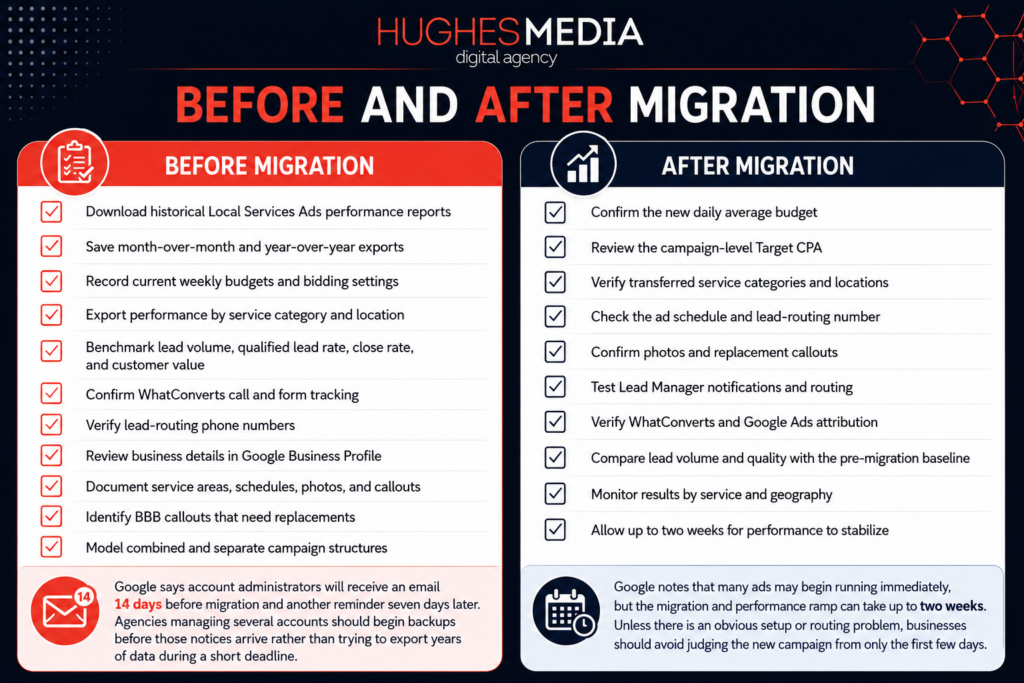
The Phased Rollout Gives Prepared Advertisers an Advantage
The first migrated accounts will reveal how Google’s unified Target CPA behaves across businesses with very different service categories. They will also show how quickly campaigns stabilize, which settings are most likely to require correction, and when separate campaigns provide enough benefit to justify dividing conversion data.
Hughes Media can monitor those early results before every client account is moved. That gives us time to improve the migration checklist, identify common issues, and adjust campaign recommendations based on real outcomes rather than assumptions.
Testing before committing is especially important for multi-service home service companies. A structure that works for a high-volume plumbing advertiser may not work for a company dividing a smaller lead pool between plumbing and HVAC. The right answer depends on actual account economics.
Why You Should Prepare Before the Migration
- Historical LSA reports become inaccessible after migration with no way to recover them
- Without independent lead tracking, you lose the ability to attribute leads to specific channels, services, or locations
- A unified Target CPA with no per-service baseline means you cannot tell if the new bidding structure is helping or hurting each service category
- Once the old dashboard redirects, there is no way to go back and export what you needed
- Clients will ask why performance shifted. Without a before picture, the only answer is “Google changed something”
Hughes Media backs up reporting, models campaign structures, and verifies lead tracking before any platform change reaches a client account. Learn more about our PPC management services.
Better Data Leads to Better Client Communication
Platform migrations create understandable questions. Clients may want to know why their dashboard looks different, why a weekly budget became a daily budget, why historical reports disappeared, or why lead costs changed after migration.
Independent reporting allows us to answer with evidence. Instead of saying that Google changed something and the old numbers are gone, we can show:
- What the account produced before migration
- Which settings Google transferred
- How each service performed
- Whether lead volume or only platform reporting changed
- How qualified lead rates compare
- What adjustments are being made and why
This is also why Hughes Media organizes campaign work, reporting, source files, and decisions through a connected Notion hub for each client. The hub aggregates across platforms so the team sees the full marketing program in one place. Moving LSAs into Google Ads reduces one context switch without changing that single view of work. Google Ads may become the single interface for Google paid campaigns, but it is not the single view of the client’s marketing program.
Why Businesses Trust Hughes Media With Paid Campaigns
Hughes Media is a Google Partner agency with more than 25 years of digital marketing experience. Our team manages PPC for local and B2B companies, with an emphasis on clean conversion tracking, lead quality, budget control, and transparent reporting.
Our approach is built around a simple principle: advertising data should help the business make decisions. A lower cost per conversion is useful only if the conversions are real, qualified opportunities. A simplified dashboard is useful only if the business still controls its history and understands what changed.
Learn more about our PPC management services and how Hughes Media connects Google Ads with landing pages, call tracking, conversion measurement, and ongoing campaign optimization.
Frequently Asked Questions About the Local Services Ads Migration
Why does Hughes Media use a Notion hub for campaign management?
Because advertising platforms come and go, but the business record needs to survive. Each client gets a connected Notion hub that stores monthly reports, source exports, campaign decisions, and lead data in one place. When a platform changes its dashboard, migrates its campaigns, or makes old reports inaccessible, the client’s reporting history stays intact. The LSA migration is exactly that scenario: Google is about to close the old LSA dashboard, but client data lives on in Notion.
Why is moving Local Services Ads into Google Ads a good thing?
Managing LSAs and Google Ads in separate dashboards meant logging into two platforms, cross-referencing data manually, and maintaining duplicate business information. Bringing them together means budget decisions can be made with the full paid picture in one view, lead management is centralized, and business details sync automatically from Google Business Profile. For agencies managing multiple campaign types per client, that means faster decisions and less administrative overhead.
How does Hughes Media report Google Ads performance alongside other channels?
Hughes Media tracks leads independently through platforms such as WhatConverts and organizes all reporting in each client’s Notion hub. Google Ads data sits alongside organic search, local SEO, call tracking, and other channel data in the same place. When a client asks how paid campaigns compare to organic or how a platform migration affected lead quality, the answer comes from independent tracking, not from one platform’s self-reported numbers.
Prepare Your Local Services Ads Data Before Google Moves It
Moving Local Services Ads into Google Ads should simplify campaign and lead management. It should not erase the historical context your business needs to evaluate results.
Hughes Media helps businesses preserve reporting, track qualified leads across channels, and make campaign structure decisions based on service-level economics. Schedule a discovery call to review your paid media tracking and prepare for the Local Services Ads migration.
About the Author:

Jason Pollak
Jason Pollak is the SEO Lead for Hughes Media. He is a full-funnel marketing strategist with over 12 years of experience in SEO, paid media, and digital strategy. He has helped brands across local services, eCommerce, B2B, and SaaS grow their online presence and drive measurable revenue. His work spans local search optimization, paid campaigns, and conversion strategy.