

By the Hughes Media Team
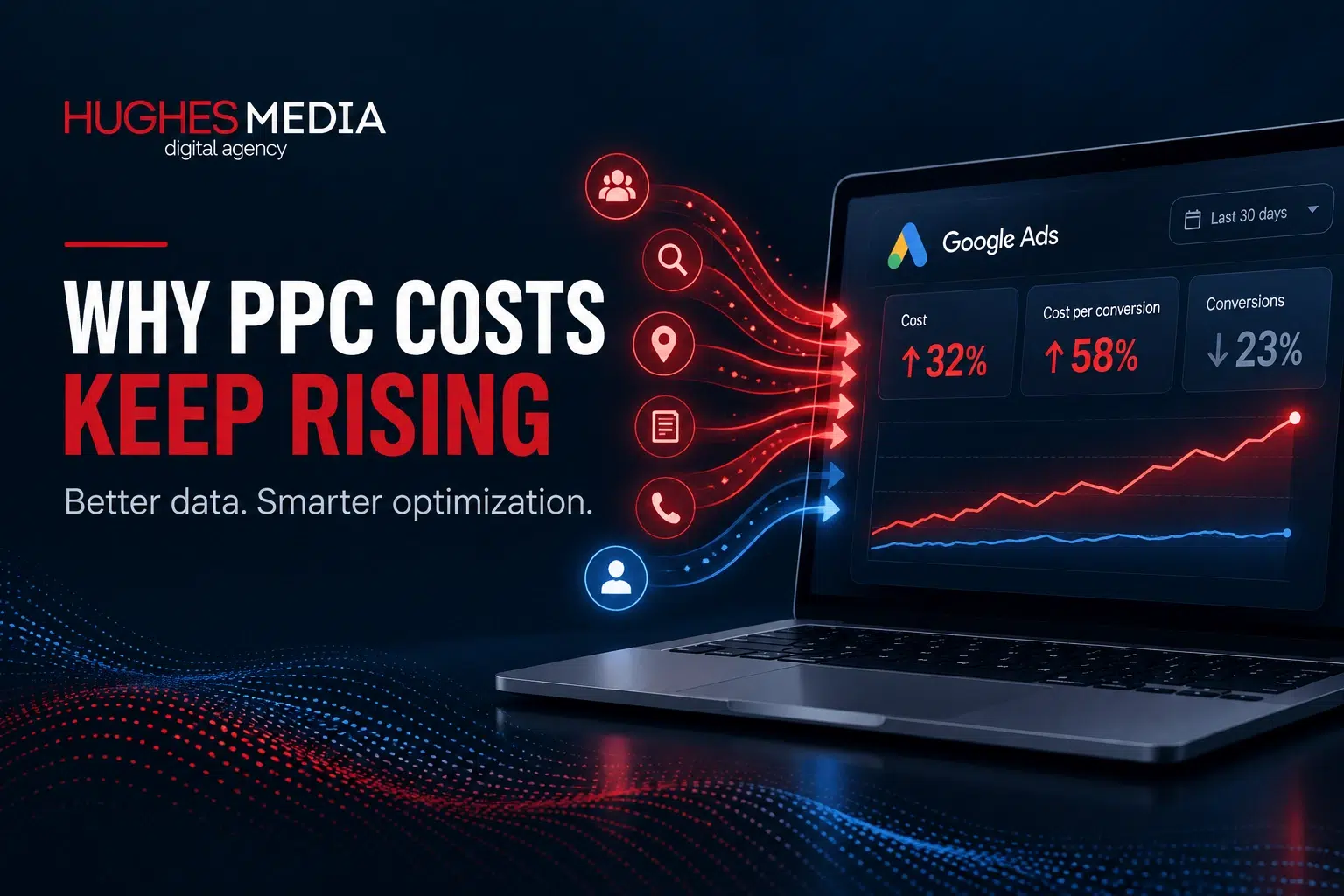
If your cost per lead has been climbing quarter after quarter, the instinct is usually to blame the auction: more competitors, higher bids, broader match types. Those forces are real. But in most accounts we audit, the bigger driver is quieter. Google Ads is optimizing toward the wrong signals, and the system is doing exactly what the data tells it to do.
That is the uncomfortable version of the good news. Rising PPC costs are usually a signal problem, and signal problems are fixable without a bigger budget.
Hughes Media is an Atlanta-based digital marketing agency that has helped businesses grow online since 2002. We are a certified Google Partner, and we manage paid media alongside SEO and conversion strategy so clients get measurable lead growth, not just traffic.
What You Will Learn About PPC Costs
This post explains where rising cost per conversion actually comes from, how to read the signals your account is sending Google, and which fixes lower costs without touching the budget.
- Why duplicated and mislabeled conversion tracking inflates costs
- How search-term leaks, regional waste, and landing page mismatch compound each other
- A checklist for judging whether your account is optimizing toward real leads
Quick Summary: Where the Money Leaks
| Leak | What It Looks Like | Fix |
|---|---|---|
| Phantom conversions | Forms firing twice, calls counted as two actions | Rebuild tracking in GTM, one event per action |
| Non-sales conversions | Recruiting and vendor forms converting like customers | Separate primary from secondary actions |
| Query waste | DIY, job, and definitional searches eating budget | Weekly search-term review, themed negatives |
| Geographic waste | Spend in regions that never close | Bid by close rate, not reach |
| Page mismatch | Expensive clicks landing on pages that do not convert | Match the page to the ad group’s intent |
Why PPC Costs Rise Even When Your Budget Stays the Same
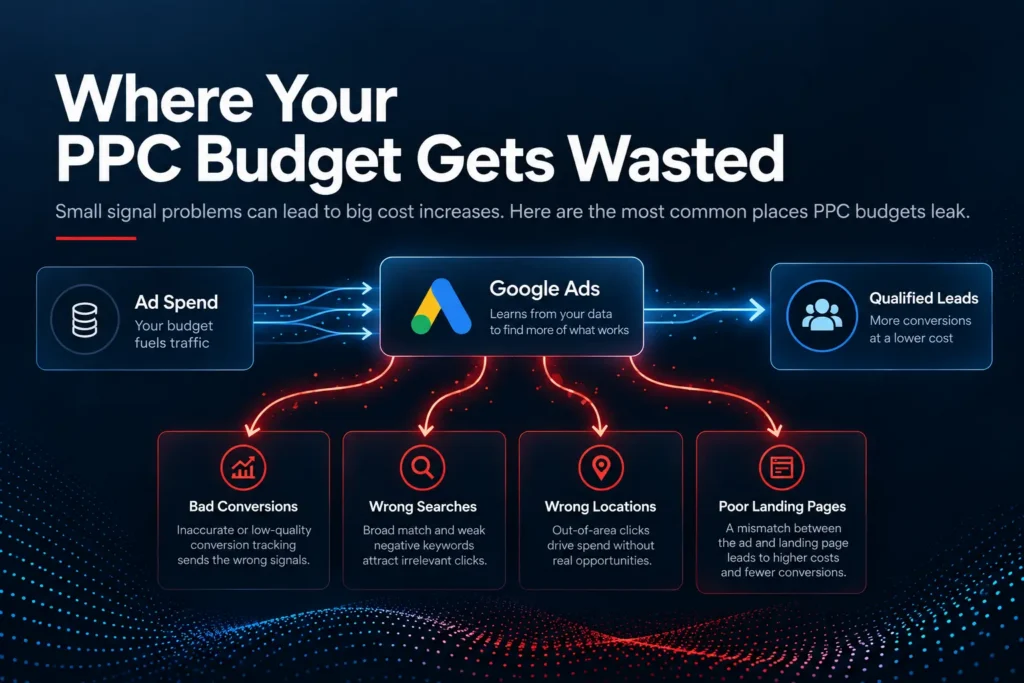
Cost per conversion climbs when Google Ads learns from noisy data, because Smart Bidding bids up the behavior it can see instead of the behavior that pays. The account keeps spending the same dollars while buying worse leads, and the reports show nothing wrong because nothing is technically broken. The symptoms arrive slowly: the same monthly spend produces fewer qualified conversations, sales complains about lead quality, and the cheapest campaigns twelve months ago are now the most expensive. Every one of those patterns traces back to what the system was told a conversion looks like.
Bad Tracking Creates Bad Bidding Decisions

Smart Bidding is only as good as its inputs, and when Google Ads cannot tell which leads are real, it cannot find more of them. The tracking stack has to be built in the right order for the bidding system to receive honest data. Google Tag Manager should be the single source of tag firing so nothing double-counts through hardcoded scripts. GA4 should receive clean events with key events marked deliberately rather than by default. Google Ads conversions should import from that stack with primary actions separated from secondary ones, because primary actions feed bidding while secondary actions are reporting only. Call tracking should tie every call back to source and campaign, not just count totals.
When a client came to us with rising costs, rebuilding this foundation was the first move rather than a bid strategy change. That account ended up cutting cost per conversion by 47%, and the tracking rebuild was the reason every later optimization paid off. The same data-first logic drives how we approach home services marketing generally: measure what actually signals a customer before spending against it.
Search Terms Reveal Where the Budget Is Leaking
Search-term review is not a one-time cleanup but the ongoing discipline that keeps an account honest. The queries that drain B2B budgets fall into recognizable patterns: DIY intent like “how to” and “template,” job seekers searching careers and salaries, definitional searches asking what something means, out-of-scope services you do not actually offer, and consumer intent landing inside a B2B campaign. Each of those clicks costs the same as a customer click and teaches the algorithm nothing about finding the next one. Grouped negative keyword lists, reviewed weekly, keep the leak from compounding. It is unglamorous work, and it is one of the highest-leverage hours in paid account management.
Regional Targeting Keeps Spend Where the Business Can Win
Plenty of companies say they serve the whole country, but almost none close at the same rate everywhere. Lead quality varies by sales coverage, service capability, delivery range, and competitive density, which means equal bidding across regions quietly funds the weakest ones. Campaigns should bid aggressively where close rates are strongest and pull back or exclude regions that produce volume but never revenue. When we realigned that same client’s spend toward their proven territories, cost per conversion fell alongside it, because the auction was suddenly competing for clicks that had somewhere to go.
Landing Pages Are Part of the PPC Budget
Every click gets more expensive when the page does not convert, and a rising cost per conversion is often a conversion problem wearing a bidding costume. The page-level fundamentals decide whether paid traffic pays for itself. Message match from keyword to ad to headline confirms the visitor is in the right place instantly. One clear CTA outperforms competing requests. Mobile form friction, short fields and no unnecessary steps, removes the quietest conversion killer. Page speed is a conversion variable, not just an SEO checkbox. Proof placed near the decision, testimonials and results matching the buyer’s intent, gives the click a reason to become a lead. This is also why our website design work and our media work stay in one shop: the page is where the budget converts or dies.
The Better Data Checklist
Run your account against this list. Are primary conversions separated from secondary actions? Are form fills and calls tracked exactly once per action? Is call tracking tied back to source and campaign? Are search terms reviewed weekly rather than quarterly? Are negative keywords grouped by theme so they scale? Are locations reviewed by lead quality, not just click volume? Does each landing page match its ad group’s intent? If more than two answers are no, the account is optimizing toward noise, and no bidding strategy will fully compensate.
Why Businesses Trust Hughes Media With PPC
We have managed paid search since 2002, long enough to watch every auction mechanic change and to learn which fundamentals do not. As a certified Google Partner, our Atlanta PPC management team pairs media buying with the tracking, analytics, and conversion work most agencies treat as someone else’s job. Clients keep ownership of everything we build, see transparent reporting, and can leave without long-term contracts. The 47% case study above is the standard we hold our own work to.
FAQs About Rising PPC Costs
How much of my Google Ads budget should go to tracking before optimization?
Fix tracking first, always, because optimization against bad data simply automates the wrong decisions. Most accounts need their conversion definitions, tag firing, and call attribution rebuilt before a single bid strategy changes. The budget split is not dollars, it is sequence: tracking is the prerequisite work that makes every later dollar smarter.
Is a rising cost per conversion always a sign to increase bids or budget?
No, it is usually a sign the account is buying the wrong clicks or counting the wrong outcomes. Rising costs trace to phantom conversions, query waste, regional mismatch, or landing pages that do not convert more often than they trace to genuine auction pressure. Audit the signals before feeding the auction more money.
How long does a tracking rebuild take before costs improve?
Most tracking rebuilds take two to four weeks to implement and let the bidding system relearn, with cost improvements appearing in the following one to two conversion cycles. Results come from the sequence, not from any single dramatic change. Accounts with heavy call volume or complex sales cycles sit on the longer end.
What is the difference between primary and secondary conversion actions?
Primary conversion actions feed Smart Bidding, so the algorithm optimizes toward them, while secondary actions exist for reporting and analysis only. Mixing high-value customer actions with newsletter signups or pageviews under a single primary label teaches Google to chase cheap noise. Separating them is one of the fastest wins in most underperforming accounts.
Start With the Data, Not the Budget
When costs rise, the reflex is to outbid the problem. The better first move is a tracking and account audit: find the phantom conversions, the leaking queries, the mismatched pages, and the regions that never close, then let the bidding system work with honest inputs. The full walkthrough of how that played out in a real account is in the case study, and the broader picture of building pipeline that holds up under auction pressure is in our lead generation strategy guide. If you want a second pair of eyes on your own account, talk to our team about a paid media audit, or read how we applied the same data discipline to search as AI changes it.
About the Author:

Jason Pollak
Jason Pollak is the SEO Lead for Hughes Media. He is a full-funnel marketing strategist with over 12 years of experience in SEO, paid media, and digital strategy. He has helped brands across local services, eCommerce, B2B, and SaaS grow their online presence and drive measurable revenue. His work spans local search optimization, paid campaigns, and conversion strategy.