


Plumbing SEO Guide
How Plumbers Can Rank Locally and Generate More Qualified Leads
Learn how local SEO, technical improvements, helpful content, and AI-ready optimization can help your plumbing company attract more qualified leads.
Schedule a Plumbing SEO Consultation- LOCAL SEARCH VISIBILITY
- TECHNICAL AND CONTENT SEO
- AI SEARCH READINESS
Why SEO for Plumbers Requires More Than Keywords
When homeowners need help with a leak, clogged drain, water heater issue, or urgent plumbing problem, the search often begins online. If a plumbing company is difficult to find in Google Maps, organic results, AI answers, or local service searches, those calls may go to a competitor.
SEO for plumbers requires more than adding a few keywords to a website. Search engines evaluate the company’s services, locations, credentials, reviews, website structure, and ability to satisfy the customer’s intent. AI systems also depend on clear, consistent information about the business, its services, and the areas it serves.
Hughes Media combines SEO for home services with home services marketing to support service-area visibility, technical performance, schema, content, paid search, website optimization, and lead tracking.
What This Plumbing SEO Guide Covers
Use this guide to understand the connected parts of a plumbing SEO strategy, then explore the sections most relevant to your website and service area.
How Plumbing SEO Works Across Search and AI
A complete strategy connects local visibility, website performance, useful content, AI readiness, and proof. Each area supports a different part of the customer journey.
| SEO Area | What It Includes | Why It Matters | Best For |
|---|---|---|---|
| Local SEO for Plumbers | Google Business Profile, service areas, reviews, local pages, and citations | Captures high-intent searches in the company's service area | Plumbing companies that rely on calls from specific cities or neighborhoods |
| Technical SEO | Site speed, mobile usability, crawlability, schema, redirects, and indexing | Makes it easier for search engines to crawl, understand, and rank the website | Older plumbing websites, redesigned sites, and sites with weak performance |
| Content Strategy | Service pages, city pages, FAQs, blogs, case studies, and internal links | Matches service-specific searches with pages that can convert visitors into leads | Companies competing across multiple services or locations |
| AI Tools and AEO | AI-assisted research, FAQ planning, schema, consistent business information, and answer-focused content | Supports visibility in AI Overviews and answer engines while improving content planning | Plumbers preparing for how search is changing |
| Case Study Proof | Davis & Sons Plumbing strategy, website ownership, trust, and conversion improvements | Shows how website ownership, technical SEO, and a full rebuild create a stronger digital foundation | Business owners comparing SEO partners |
Local SEO for Plumbers
Local SEO for plumbers helps a company appear when customers search for plumbing services in a particular city, neighborhood, or service area. Searches such as “plumber near me,” “emergency plumber,” “water heater repair,” and “drain cleaning near me” often carry high intent because the customer may need professional help soon.
A strong local plan begins with a complete Google Business Profile and consistent business information across the web. The company’s primary categories, services, hours, service areas, photos, website, and phone number should make it easy for potential customers to confirm that the business is relevant and available.
Local visibility checklist:
- Complete and accurate Google Business Profile information
- Consistent name, address, phone number, and website details
- Service categories aligned with the company’s actual plumbing services
- Service areas that reflect where the company operates
- A review strategy with timely, professional responses
- Original city and service pages that avoid thin or duplicated copy
- Local schema and accurate contact information
- Internal links connecting services, locations, articles, and proof
Search visibility should also reflect urgency. A customer with an active leak does not need vague marketing language. They need service-area clarity, evidence of professional service, and a fast path to call or request an appointment. For a deeper checklist, read how to optimize a plumbing website for local SEO.
Technical SEO for Plumbing Websites
SEO for plumbers depends on a technical foundation that search engines can crawl and understand. A slow, confusing, or poorly structured website can limit the performance of otherwise useful content.
Priority work includes mobile speed, clear URLs, accurate title tags and meta descriptions, one H1, and an organized H2 and H3 hierarchy. Service and city pages should remain indexable, and redirects, XML sitemaps, robots.txt files, and internal links should be reviewed during redesigns or migrations.
Appropriate LocalBusiness, Service, FAQPage, Article, and BreadcrumbList schema can help define the business and page content. Conversion tracking should connect SEO activity with calls, forms, and booked appointments instead of treating traffic and rankings as the only measures of success.
Technical planning also protects existing lead generation. When a redesign changes important URLs, removes ranking content, or launches without redirects, organic visibility can decline quickly.
Technical priorities:
- Mobile speed and Core Web Vitals
- Crawlable service and location pages
- Redirects for changed or retired URLs
- Clear metadata and heading structure
- XML sitemap and robots.txt review
- Relevant schema markup
- Call and form conversion tracking

Content Strategy for Plumbing Companies
A plumbing company SEO strategy should begin with evidence, not a disconnected list of post ideas. Google Search Console can show which searches already generate impressions and clicks, while rank-tracking tools can reveal position changes and competitor visibility. A home services marketing plan should use those signals to decide what to create, refresh, consolidate, or retire.

Start With Search and Competitor Data
Research should begin with an audit of the company’s website and relevant competitors. Reviewing service pages, location content, articles, FAQs, and ranking queries can reveal important services without dedicated pages, customer questions that are not answered clearly, and topics where competitors appear but the company does not.
PROOF POINT: For Davis & Sons Plumbing, this process produced more than 100 recommended blog topics organized into 25 content clusters. The roadmap placed topics into a 12-month calendar, with 25 held for a later phase so the strategy could adapt to business priorities.
The goal is not to publish an arbitrary number of articles each month. The goal is to create useful options and make informed pivots when client priorities, search behavior, or the competitive landscape changes.
Existing performance matters too. A page earning strong impressions but ranking below the top results may be a better refresh candidate than an entirely new article. The right response could be a better intent match, stronger original proof, deeper coverage, or improved internal links.
Make Service Pages the Foundation
Content should be organized around the services that generate calls. Drain cleaning, water heater repair, sewer line replacement, leak detection, repiping, emergency plumbing, and other major services generally deserve dedicated pages that match the customer’s specific need.
Each service page should explain what the service includes, warning signs a customer may notice, what to expect during the visit, where the company works, and why the company is qualified. A visible phone number or booking action should make the next step easy.
Articles should support those service pages rather than compete with them. A post about water-heater warning signs can answer the customer’s immediate question and then guide the reader to the relevant repair page.
Turn Customer Questions Into a Calendar
Useful topics come from the intersection of search data, competitor gaps, and first-party customer questions. Call-tracking platforms such as WhatConverts can surface recurring concerns about price, urgency, and what happens during a service visit. Those patterns become stronger content ideas when reviewed alongside search demand and the services the company actually offers.
Seasonal demand should influence publication timing. Frozen-pipe prevention belongs ahead of winter weather, while drain maintenance, plumbing inspections, and water-heater maintenance can be scheduled before expected interest rises. Publishing early gives search engines time to crawl and evaluate the content.
Consolidate Overlapping Content
When several posts address the same search intent, consolidating them into one stronger guide can reduce internal competition and create a clearer primary resource. Supporting posts can remain when they cover distinct angles, but they should link to the primary guide and avoid repeating the same answer.
This plumbing SEO guide follows that approach by serving as the main strategic hub while the four supporting articles provide deeper coverage of local optimization, SEO fundamentals, local visibility, and AI-assisted work.
Structure Content for Search, AI, and Leads
Each section should answer its heading directly and contain enough context to stand on its own. FAQs should add useful information rather than merely repeating the body, while appropriate schema helps search engines interpret the page structure.
Original proof such as case studies, service guarantees, project details, credentials, and verifiable results gives a plumbing website information competitors cannot simply duplicate. Accurate call, form, and booked-job tracking can then connect content activity to lead quality more reliably.
AI Tools for Plumber SEO
AI tools for plumber SEO can accelerate research, organization, and first-draft production, but they do not replace strategy or specialist review. Hughes Media uses AI to organize service and location terms, group customer questions, identify overlapping pages, and build structured drafts for review.
The company’s actual services, service areas, credentials, processes, and customer experience must remain the source of truth.

Where AI Speeds Up Production
AI can organize large groups of search queries into themes, compare content outlines, identify possible gaps, and suggest relevant internal links. It can also help structure approved case-study notes, draft metadata within practical length guidelines, and organize schema requirements for technical validation.
For plumbing companies with a useful library of customer questions, service details, project photos, guarantees, and location information, AI can make that approved material easier to find and reuse.
Why Company-Specific Information Matters
Generic copy provides little original value because it could describe almost any plumbing company. Useful AI-assisted content should be grounded in the company’s real services, locations, processes, proof, and customer needs.
Answer engine optimization, or AEO, depends on clear and reliable information about services, locations, credentials, and proof. Complete passages with direct answers and enough context are generally more useful than disconnected one-line responses. Clear FAQs and schema can help machines interpret the page, but they do not guarantee an enhanced result or AI citation.
How AI Supports Technical Content Work
AI can help identify where service pages and articles should link, flag possible title or topic overlap, and organize potential schema fields. It can also group recurring call themes and customer questions into FAQ or article ideas. These outputs remain starting points that should be validated against the website and approved business information.
Why Specialist Review Is Required
Every AI-assisted claim should be verifiable. Every service reference should match what the company offers, and every location mention should reflect the real service area. A specialist should review drafts for accuracy, brand fit, duplication, technical validity, and usefulness to an actual customer.
Website Ownership Case Study: Davis & Sons Plumbing
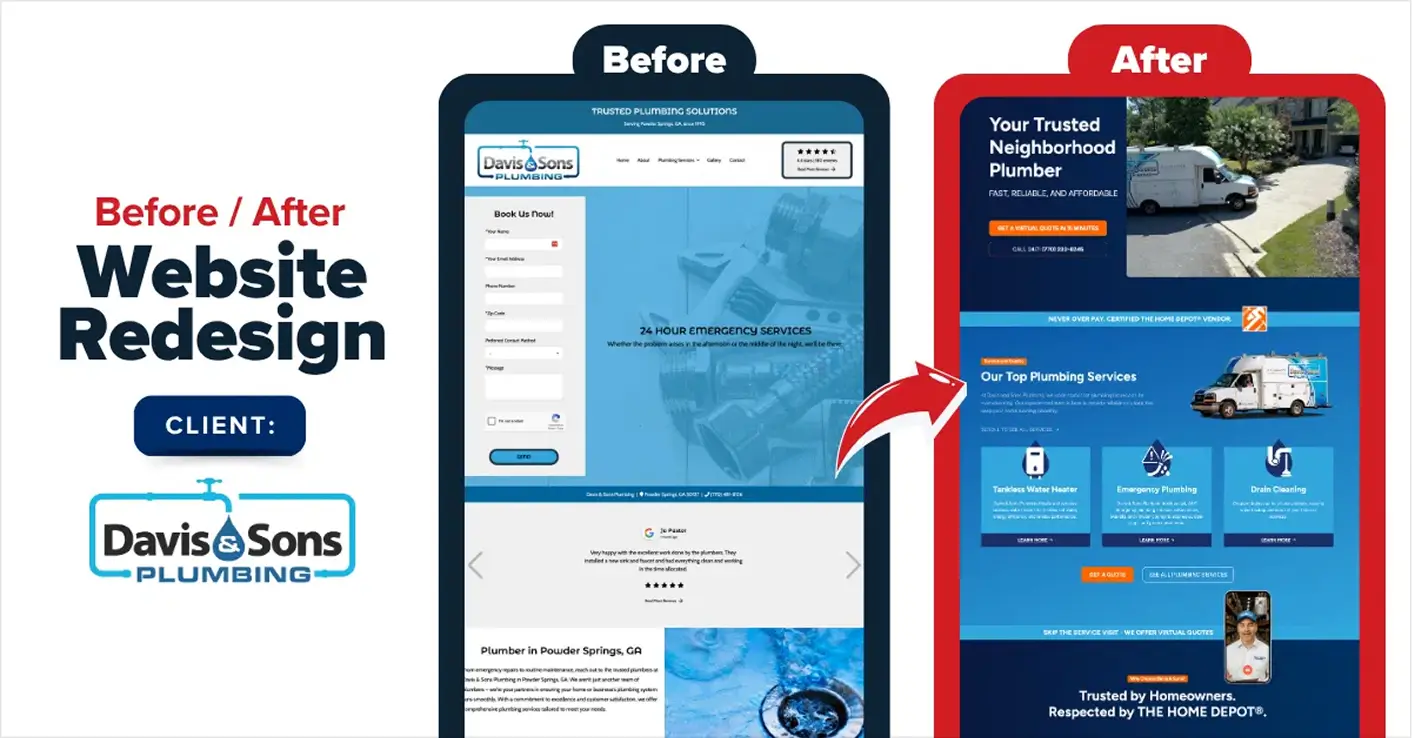
Davis & Sons Plumbing demonstrates why website ownership matters alongside search visibility. After a previous agency took the company’s site offline, Hughes Media launched an emergency microsite and rebuilt the company’s digital foundation on a client-owned WordPress website.
The Davis & Sons Plumbing website ownership case study explains how the rebuild added custom development, dedicated service and location content, clear calls to action, and technical SEO. Hughes Media’s approach also emphasizes transparent ownership, local visibility, and conversion tracking.
Davis & Sons Plumbing’s service guarantee provides another trust signal. When the warranty is mentioned, retain the link to the official Davis & Sons Plumbing service guarantee.
Review the Davis & Sons Case Study
How to Build a Plumbing SEO Strategy
01 / Audit your website and local visibility.
Review rankings, Google Business Profile performance, service pages, city pages, technical issues, and conversion tracking.
02 / Map services to search intent.
Identify which services need dedicated pages and which can be supported through FAQs, blogs, or service-area content.
03 / Strengthen local SEO signals.
Update Google Business Profile details, citations, reviews, service areas, and local landing pages.
04 / Fix technical SEO issues.
Improve speed, mobile usability, indexation, redirects, metadata, internal links, and schema markup.
05 / Build a content plan.
Create service pages, city pages, blogs, FAQs, and case studies that answer real customer questions.
06 / Use AI tools carefully.
Use AI for research and organization, then have an SEO specialist review for accuracy, brand fit, and helpfulness.
07 / Track calls and forms.
Measure qualified leads, not only traffic or rankings.
08 / Review and improve monthly.
Use performance data to update pages, expand internal links, and refine the strategy.
Every engagement follows this sequence, scaled to your services, locations, and current search visibility. Start with an audit and a prioritized plan.
Schedule a Local SEO ConsultationFAQ About Plumbing SEO
Plumbing SEO pricing depends on the number of service areas, the condition of the website, competition, and whether the engagement includes content, technical fixes, or website development. Hughes Media scopes the work after reviewing the site, priority services, and lead goals so the proposal reflects what the company needs.
SEO builds long-term visibility, while Google Ads for home services can generate demand sooner for priority services. Many plumbing companies use both: paid search supports immediate lead flow while SEO builds map and organic visibility over time.
Look for home-services experience, transparent website ownership, technical SEO capability, lead tracking, and a plan tied to calls and booked jobs rather than rankings alone. Ask who owns the website and content, how reporting works, and how the agency creates service-area pages without duplicating copy.
Some improvements, such as technical fixes or Google Business Profile updates, can help quickly. Larger SEO gains usually take several months because rankings depend on competition, content quality, website authority, reviews, and ongoing optimization.